Views: 0 Author: Site Editor Publish Time: 2026-10-16 Origin: Site


For material handling and light-to-medium duty conveying, selecting the correct chain architecture is critical. Your choice directly minimizes drive-power requirements and extends the overall lifecycle of your mechanical system. Engineers and procurement teams often debate the merits of single-pitch versus double-pitch configurations. Over-speccing a system results in unnecessary equipment weight and inflated upfront material expenses. Conversely, under-speccing the drive leads to premature chain elongation, severe track wear, and eventual catastrophic failure on the production line.
This comprehensive guide deconstructs double-pitch chains to clarify these engineering dilemmas. We analyze how modified pitch lengths interact with physical load limits and dynamic operational speeds. You will also discover how precise custom attachment spacing helps you finalize your drive specifications accurately and safely.
Understanding ANSI/ASME B29.4 standards forms the baseline for any conveyor project. These standards dictate the physical dimensions and structural integrity of the chain. When reviewing double pitch conveyor chain specifications, you will notice a clever engineering trick. A double-pitch chain retains the exact pin diameter, roller width, and plate thickness of a standard single-pitch chain. For example, a C2040 chain shares the exact component dimensions of an ANSI 40 chain. The only difference is the pitch length, which doubles from 0.5 inches to 1.0 inch.
This modified geometry creates a much lighter chain. It spans long distances using fifty percent fewer pins, bushings, and rollers per foot. This reduction directly translates to a leaner, highly efficient material handling setup.
You must choose between standard and oversized rollers based on your track design. This decision determines how the chain interacts with the guide rails.
Matching your chain material to the environmental conditions is non-negotiable. Standard carbon steel chains perform excellently in dry, indoor industrial environments. However, moisture and chemicals demand alternative treatments. Washdown environments or food-grade applications require stainless steel. 304 stainless offers broad chemical resistance, while 316 stainless handles extreme corrosives. If you need a middle ground between carbon steel strength and basic corrosion resistance, nickel-plated chains offer excellent ambient protection.
Best Practice: Always evaluate the ambient temperature and chemical exposure before selecting a chain material. Using carbon steel in a high-humidity environment guarantees rapid oxidation and premature joint failure.
| Roller Type | ANSI Series Example | Primary Motion | Ideal Application | Friction Profile |
|---|---|---|---|---|
| Standard Roller | C2040, C2050, C2060 | Sliding / Dragging | Scraper flights, timber sorting | Higher sliding friction |
| Oversized (Carrier) | C2042, C2052, C2062 | Rolling | Pallet handling, assembly lines | Lower rolling friction |
Engineers frequently confuse Ultimate Tensile Strength with Working Load Limits (WLL). We must clarify this difference immediately. Ultimate Tensile Strength measures the exact point where the chain snaps under a static load. You should never use this metric to size your operational system.
Decision-makers must size their systems based entirely on the Working Load Limit. The WLL typically represents one-sixth to one-ninth of the ultimate tensile strength. It provides a mandatory safety buffer. Designing a system anywhere near the failure point guarantees sudden line stoppages and dangerous workplace conditions.
While the tensile strength of a double-pitch chain matches its single-pitch counterpart, the internal stress distribution changes significantly. The longer pitch means you have fewer load-bearing joints per foot. Consequently, each pin and bushing takes on a higher percentage of the continuous load. You must calculate dynamic loads carefully to ensure you do not crush the localized bearing areas.
Chain elongation happens when internal pins and bushings wear down. It is not the steel plates stretching. Cyclic loading accelerates this internal wear. As the chain repeatedly tensions and relaxes around the sprockets, the joints grind against each other. Extended link plates amplify these stress points slightly compared to short-pitch chains.
If your application involves sudden starts, abrupt stops, or mild shock loads, standard plates might fatigue. You should evaluate heavy-duty series chains (such as the C2040H). Heavy-duty chains utilize thicker link plates borrowed from the next size up. They absorb shock waves better and fiercely resist premature elongation.
The mechanical reality of how double-pitch chains engage sprockets dictates their speed limits. This behavior relies entirely on the polygonal effect, commonly known as chordal action.
When a chain wraps around a sprocket, it forms a polygon rather than a perfect circle. As the links enter and exit the sprocket teeth, the chain physically rises and falls. The larger the pitch, the greater this vertical rise-and-fall action becomes. A double-pitch chain creates a much larger polygon than a standard chain. This geometry induces a pronounced pulsing effect across the conveyor line.
Because of chordal action, we restrict double-pitch chains strictly to "low and moderate" speed operations. Typically, this means staying below 150 feet per minute, depending on the sprocket size. Exceeding manufacturer speed thresholds triggers severe mechanical consequences. The vertical pulsing violently translates into chain whip. This whipping action accelerates pin galling, destroys wear strips, and eventually shatters guide rails.
Pairing the chain with the correct sprocket is a critical step when finalizing double pitch conveyor chain specifications. You generally have two choices: single-cut or double-cut sprockets.
We highly recommend utilizing double-cut sprockets. They feature an odd number of teeth. Because the chain only engages every second tooth on a given revolution, the odd-tooth design forces the chain to alternate tooth engagement. The chain engages one set of teeth on the first rotation and the alternate set on the second rotation. This brilliant engineering trick effectively doubles the operational life of the sprocket.
Operational speed directly dictates your lubrication methods. If you run a slow, intermittent line, manual application or drip lubrication suffices. Moderate speeds demand an enclosed oil bath to dissipate heat and flush away debris.
Sometimes, external lubrication contaminates the product being conveyed, such as in paper packaging or textile handling. In these scenarios, self-lubricating variants featuring oil-impregnated sintered bushings offer a perfect solution. They release oil dynamically during operation and reabsorb it when the chain stops moving.
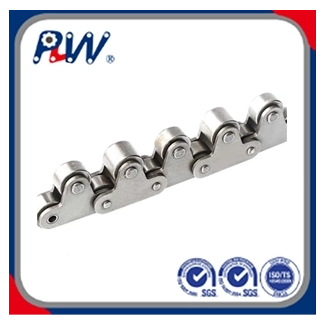
Standard chains simply transmit power. Attachments transform them into specialized material handlers. Properly configuring a double-pitch conveyor chain with attachments requires evaluating shapes, orientations, and spacing intervals.
Manufacturers classify attachments into several standard geometries. Selecting the right one ensures your product stays stable on the line.
You must calculate precise spacing intervals. You can place attachments on every single link, every second link, or every 'nth' link. Tight spacing intervals handle small, dense products but dramatically increase the total chain weight. Wider intervals save material costs but require larger products to bridge the gaps.
Implementation Risk: You must watch out for asymmetrical loading. Uneven attachment spacing or off-center payloads cause the chain to twist. This torsional twist violently gouges the track. It forces the internal bushings to wear unevenly against the pins, drastically shortening the chain's lifespan. Always keep the center of gravity aligned directly over the chain centerline.
Standard attachment configurations keep your project timeline and budget intact. Manufacturers stock chains with attachments spaced on every even-numbered pitch. Specifying engineered-to-order spacing fits highly specialized automation cells perfectly. However, custom punching and assembly processes extend lead times. They also complicate future maintenance since replacement segments must be custom-ordered rather than pulled from a standard catalog.
Making the final call requires a clear understanding of your operational boundaries. Double-pitch chains are incredibly effective, but they are not universal solutions.
You should specify double-pitch configurations when dealing with long center distances. They shine in applications characterized by steady, predictable loads and low operational speeds. If you face strict budget constraints on large-scale material handling installations, the reduced component count per foot provides immediate relief without sacrificing structural integrity.
Do not force a double-pitch chain into the wrong application. If your production speeds exceed standard operational thresholds, you must revert to a single-pitch roller chain. The shorter pitch handles high RPMs with significantly less vibration.
Furthermore, if your application involves heavy impact loading, sudden jams, or extreme abrasives, standard roller chains might fail entirely. In these brutal environments, you should evaluate engineered steel drop-forged chains or heavy-duty cast chains instead.
Before you contact a manufacturer for technical drawings and quotes, prepare your procurement data carefully. Follow these steps to ensure accurate sizing:
Double-pitch conveyor chains offer a highly efficient, cost-effective solution for specific material handling envelopes. By utilizing fewer components per foot, they lighten the overall system and stretch budgets across long center distances. However, they demand strict adherence to technical limitations. You must respect the physical boundaries regarding chordal action, operating speed, and localized pin stress.
Finalize your drive specifications by validating your maximum dynamic load against the manufacturer's working load limits. Do not rely on ultimate tensile strength. Ensure your attachment spacing aligns symmetrically with your payload to prevent torsional twist. Finally, confirm your sprocket and guide rail architecture supports the specific roller type you select. Taking these calculated steps ensures a smooth, durable, and highly reliable conveying system.
A: Standard oversized rollers require specific double-pitch sprockets because they need deeper seating grooves. However, if you use a double-pitch chain with standard rollers, you can sometimes use single-pitch sprockets provided they have 30 or more teeth. Despite this compatibility, we strongly recommend dedicated double-cut sprockets to ensure proper wear distribution and extend system life.
A: Oversized rollers do not change the ultimate tensile strength or the working load limit of the chain itself. Instead, they drastically reduce sliding friction. By converting dragging motion into rolling motion, they significantly lower the required horsepower and drive load, allowing the motor to run much more efficiently.
A: While you can place attachments on every link, industry standards typically space them on every even-numbered pitch (such as every 2nd, 4th, or 6th link). This standard approach maintains symmetrical balance, prevents torsional twist, and guarantees predictable, faster manufacturing lead times for replacement parts.


