1. Introduction
Have you ever wondered what makes gears run smoothly in machines and vehicles? Helical gears play a key role in transferring power and motion efficiently. In this article, we’ll dive into the differences between single and double helical gears. By the end, you’ll understand their unique features and which one fits your needs best.
2. What Are Helical Gears?
Definition and Basic Functionality
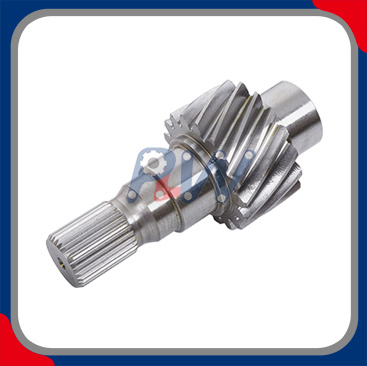
Helical gears are gears that have teeth that are cut at an angle to the axis of rotation, rather than being parallel to it. This angled tooth design allows for gradual and smooth meshing between the gears as they rotate, leading to less vibration, reduced noise, and more efficient power transfer compared to straight-cut gears. The teeth of helical gears engage more gradually, which means that there is a more consistent load distribution across the teeth during meshing. This, in turn, leads to lower stress on the teeth and higher durability under heavy loads and high-speed conditions.
The key benefit of helical gears is that they generate smoother motion, particularly when compared to other types of gears, such as spur gears. Their ability to transmit high levels of torque efficiently makes them suitable for a wide range of applications, from low-speed precision machinery to high-speed power transmission systems.
Common Uses
Helical gears are widely used across various industries due to their versatility. Some of the most common applications include:
● Automotive Systems: Helical gears are essential in vehicle transmissions, where smooth and efficient power transfer is crucial. They are also used in differential systems, helping distribute power to the wheels.
● Industrial Machinery: Gearboxes and motors rely on helical gears for smooth power transmission, especially in machines that operate at high speeds or require precision.
● CNC Machines: Helical gears are used in CNC systems to ensure high precision and minimal backlash in motion control.
● Pumps and Compressors: Their smooth operation is ideal for systems that require high torque and efficiency, such as pumps and compressors.
These applications highlight the broad range of environments where helical gears can excel, from general industrial applications to highly specialized systems.
3. Understanding Single Helical Gears
Design Features
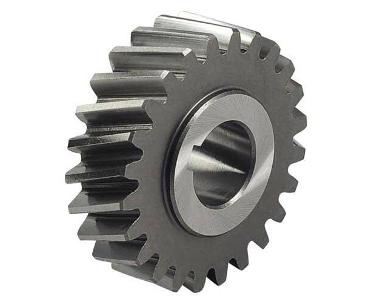
Single helical gears have teeth that are angled in one direction, and they typically operate with a single set of teeth. This design ensures that the gears mesh smoothly, but it also generates axial thrust — a force along the axis of the gear shaft. This axial thrust can place additional stress on bearings, shafts, and other components of the gear system. Single helical gears are often preferred in systems where cost-efficiency is important and the axial thrust can be managed with the appropriate bearing or support system.
The design of single helical gears is relatively simple, making them easier and cheaper to manufacture than their double helical counterparts. However, they are typically best suited for applications that do not require the highest levels of torque or noise reduction.
Advantages
● Cost-Effectiveness: Due to their simpler design, single helical gears are less expensive to manufacture and maintain compared to double helical gears.
● Compactness: The straightforward design allows for a more compact configuration, which can be beneficial in space-constrained applications.
● Ease of Maintenance: Fewer components and simpler design translate to easier maintenance and repair.
● Reliability: Single helical gears, while they produce axial thrust, still perform reliably in applications that do not involve extreme loads.
Limitations
● Axial Thrust: The key drawback of single helical gears is the axial thrust generated by the angled teeth. This thrust needs to be managed through bearings, and if not properly addressed, it can lead to premature wear and higher maintenance costs.
● Noise: While they are quieter than spur gears, single helical gears are generally louder than double helical gears due to the constant meshing of the teeth. This can be an issue in noise-sensitive applications such as in consumer products or precision machinery.
4. Exploring Double Helical Gears
Design Features
Double helical gears, also known as herringbone gears, have two sets of teeth that are arranged in a V-shape, which helps counteract the axial thrust. This design balances the forces generated by the meshing teeth, reducing the axial load on the bearings and allowing for smoother, more stable operation. The V-shape of the teeth results in better load distribution, which is particularly beneficial in high-torque and high-performance applications.
The dual-teeth design of double helical gears ensures that there is less noise and vibration during operation. Unlike single helical gears, which generate noise as the teeth engage one by one, double helical gears mesh more gradually, reducing friction and improving efficiency.
Advantages
● Reduced Axial Thrust: The V-shaped teeth of double helical gears help cancel out the axial thrust, making them ideal for applications that involve high torque and precision.
● Smoother Operation: Double helical gears operate with reduced noise and vibration, which is essential for systems where noise control is important, such as in automotive or consumer-facing applications.
● High Load Capacity: The design allows for greater surface contact, improving the gear's ability to handle higher torque and distribute the load more evenly, which increases the overall load capacity.
● Improved Durability: Due to their smoother operation, double helical gears tend to last longer than single helical gears in high-load and high-speed applications.
Limitations
● Increased Manufacturing Complexity: The design and production of double helical gears are more complex than single helical gears. The dual teeth require precise manufacturing, which increases both production time and cost.
● Higher Cost: The complexity of the design and the higher precision required for production make double helical gears more expensive than single helical gears.
5. Key Differences Between Single and Double Helical Gears
Feature | Single Helical Gear | Double Helical Gear |
Axial Thrust | Produces axial thrust | Axial thrust is balanced out |
Efficiency | Moderate efficiency (85-90%) | High efficiency (93-98%) |
Noise and Vibration | Higher noise and vibration | Lower noise and vibration |
Load Capacity | Suitable for moderate loads | Better for high torque loads |
Manufacturing Complexity | Simpler and cheaper | More complex and expensive |
Application | Cost-effective, general use | High-performance, precision |
Axial Thrust
Single helical gears create axial thrust, which can affect the lifespan of bearings and require additional components to manage the thrust. In contrast, double helical gears reduce or eliminate this thrust, which improves their stability and longevity.
Efficiency and Load Capacity
Double helical gears are more efficient, achieving transmission efficiencies between 93% and 98%, whereas single helical gears are typically less efficient (85% to 90%). This difference makes double helical gears more suitable for high-performance machinery, while single helical gears are better for general-purpose use with moderate load demands.
Noise and Vibration
Due to the dual-teeth design, double helical gears are much quieter than single helical gears, which can create more noise and vibration due to the constant engagement of their teeth. This makes double helical gears ideal for applications where noise reduction is a key factor.
Complexity and Manufacturing
The design of double helical gears requires more precision, making them more expensive to manufacture. Single helical gears are easier to produce and are therefore a more cost-effective option for less demanding applications.
6. Applications of Single and Double Helical Gears
Industries Using Single Helical Gears
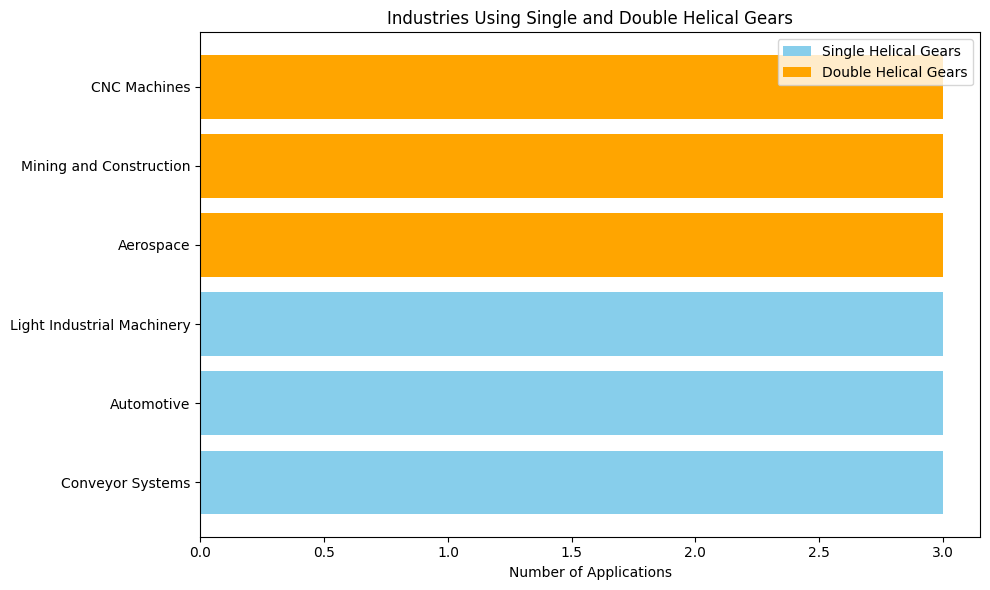
● Single helical gears are commonly used in applications where the cost of production is a significant consideration and where the load is not excessively high. These include:Conveyor Systems: In applications such as assembly lines or packaging, where the loads are moderate and axial thrust can be effectively managed. Single helical gears are an ideal choice here because they are cost-effective and perform well in systems that do not require extreme durability or high power transmission. The simplicity of their design makes them easy to integrate into various conveyor systems.
● Automotive: In automotive transmissions where noise reduction is not as critical. Single helical gears are often employed in automotive applications where cost is a priority and noise levels are less of a concern. These gears offer a balance between efficiency and affordability, making them ideal for applications in lower-performance vehicles or for certain parts of the transmission system.
● Light Industrial Machinery: In machines where cost efficiency is more important than noise reduction or handling high torque. Examples of such machinery include pumps, compressors, and small manufacturing machines. These machines do not always require the high performance and precision that double helical gears provide. Single helical gears, with their simpler and cheaper construction, are a perfect fit for these kinds of applications. They offer sufficient torque and durability without the additional cost of more complex gear designs.
Industries Using Double Helical Gears
● Double helical gears are best suited for industries that demand high performance, low noise, and the ability to handle high torque. Some of the industries using double helical gears include:Aerospace: For engines and other systems where reliability and low noise are critical. In the aerospace industry, double helical gears are essential for ensuring smooth and reliable operation of aircraft engines and other high-precision systems. These gears minimize noise and vibration while providing the necessary torque to support critical functions. The durability and high torque capacity of double helical gears make them ideal for the demanding conditions of aerospace applications, where performance and safety are paramount.
● Mining and Construction: Where high load capacity and durability are essential. The mining and construction industries rely heavily on robust gear systems that can withstand harsh conditions, high loads, and constant wear and tear. Double helical gears offer superior load handling, making them perfect for use in heavy machinery like excavators, crushers, and drilling rigs. Their ability to operate under intense pressure and their resistance to wear make them a key component in these industries.
● CNC Machines: In high-precision applications that require minimal backlash and consistent operation. CNC machines, which are used for precise cutting and shaping in manufacturing processes, require gears that can operate with very little backlash to maintain accuracy. Double helical gears meet these requirements with their smooth operation and superior load handling capabilities. They ensure that CNC machines maintain their precision over long periods of use, making them essential in high-precision applications where every detail matters.
7. When to Choose Single vs. Double Helical Gears
Cost Considerations
If you're working within a budget and the application doesn't require high torque or low noise, single helical gears are a more cost-effective solution. They are easier to produce and maintain, making them ideal for lighter-duty applications where cost-efficiency is a priority.
Performance Needs
For high-performance machinery, such as in aerospace or high-end automotive systems, double helical gears are the better choice. They provide smoother operation, higher load capacity, and lower noise, making them ideal for applications requiring high precision and reliability.
8. Conclusion
In conclusion, both single and double helical gears offer unique advantages. Single helical gears are simpler and cost-effective, making them ideal for light-duty use. Double helical gears, however, excel in load capacity, noise reduction, and efficiency, making them perfect for high-performance systems.
At Hangzhou Perpetual Machinery & Equipment Co., Ltd., we provide the right gear solutions for your specific needs, ensuring optimal performance for your machinery.
FAQ
Q: What is the main difference between single and double helical gears?
A: Single helical gears have one set of angled teeth, while double helical gears feature two sets arranged in a V-shape, which helps reduce axial thrust and improve load distribution.
Q: How do single helical gears work?
A: Single helical gears transmit power through angled teeth, creating smooth and gradual engagement, but they generate axial thrust that needs to be managed with bearings.
Q: Why are double helical gears preferred in high-performance systems?
A: Double helical gears offer better noise reduction, higher load capacity, and more efficient power transfer, making them ideal for industries like aerospace and automotive.
Q: Are double helical gears more expensive than single helical gears?
A: Yes, double helical gears are more complex to manufacture due to their design, making them more expensive compared to simpler single helical gears.
Q: In which applications are helical gears commonly used?
A: Helical gears are commonly used in automotive transmissions, industrial machinery, CNC systems, and other applications requiring efficient and smooth power transmission.

 Español
  English
  العربية
  Français
  Русский
  Português
  Deutsch
  italiano
  日本語
日本語  한국어
한국어  Nederlands
  Tiếng Việt
  ไทย
ไทย  Polski
  Türkçe
  አማርኛ
አማርኛ  ພາສາລາວ
  ភាសាខ្មែរ
  Bahasa Melayu
  ဗမာစာ
ဗမာစာ  தமிழ்
தமிழ்  Filipino
  Bahasa Indonesia
  magyar
  Română
  Čeština
  Монгол
  қазақ
қазақ  Српски
  हिन्दी
  فارسی
فارسی  Kiswahili
  Slovenčina
  Slovenščina
  Norsk
Norsk  Svenska
  українська
  Ελληνικά
  Suomi
Suomi  Հայերեն
  עברית
עברית  Latine
  Dansk
Dansk  اردو
اردو  Shqip
Shqip  বাংলা
বাংলা  Hrvatski
  Afrikaans
  Gaeilge
  Eesti keel
  Māori
Māori  සිංහල
සිංහල  नेपाली
  Oʻzbekcha
  latviešu
  অসমীয়া
  Aymara
  Azərbaycan dili
  Bamanankan
  Euskara
  Беларуская мова
  भोजपुरी


