Product Description
In the world of vertical lifting, there is no room for compromise. Every millimeter of steel in our LL Series Leaf Chains is dedicated to one thing: securing your payload with absolute certainty. Imagine the intense environment of a busy shipping port or a high-capacity warehouse. The air is thick with the scent of hydraulic fluid and the hum of electric motors. As your forklift engages, you need a chain that doesn't just "hold"—you need one that articulates with a whisper-quiet, rhythmic precision. Our leaf chains offer a tactile experience of industrial mastery; they are heavy, cold-forged, and finished with a dark, oil-infused sheen that signals readiness for the most grueling shifts.
We designed the LL series for the engineer who sleeps better knowing their equipment exceeds safety margins. Unlike standard roller chains, leaf chains consist only of stacked plates and pins, creating a sleek but incredibly dense profile. Running your hand along the links, you can feel the flawless edges of the precision-stamped plates, each one heat-treated to a state of resilient toughness. This isn't just a component; it is a story of safety and endurance. It was inspired by the need to protect both people and expensive cargo from the catastrophic risks of chain fatigue. When you install our leaf chains, you are upgrading to a level of security that transforms a high-risk lift into a routine, effortless motion.
Product Features and Highlights
The LL Series Leaf Chain is distinguished by its focused design on high-load vertical tension, featuring several core engineering advantages:
High-Strength Plate Lacing: By stacking multiple high-carbon steel plates (e.g., 4x4 or 6x6), our leaf chains achieve a tensile strength far exceeding standard roller chains of the same width. This allows for massive lifting capacity in the narrow channels of a forklift mast.
Precision-Gauged Pins: The pins are the "spine" of the chain. We use specialized alloy steel, case-hardened to resist the shearing forces that occur during rapid lifting and lowering cycles. Each pin is centerless ground to a tolerance of microns, ensuring perfect articulation.
Superior Fatigue Life: Vertical lifting is a repetitive stress task. Our link plates undergo an advanced shot-peening process that induces compressive surface stresses, effectively acting as an armor against the microscopic cracks that lead to fatigue failure.
Anti-Corrosive Lubrication: Every chain is factory-impregnated with a specialized high-pressure lubricant that penetrates the tight clearances between the plates and pins. This reduces internal friction and prevents the "rust-frozen" links that can lead to sudden snapping.
Manufacturing Excellence & Safety Standards
Safety is the cornerstone of our manufacturing philosophy. Following the E-E-A-T framework, we ensure that every meter of our LL series leaf chain is a testament to professional engineering and rigorous testing.
Optimized Plate Stamping: We use high-precision progressive dies to stamp each plate. This ensures that the pitch holes are perfectly aligned across all plates in a stack, distributing the load evenly and preventing any single plate from taking the brunt of the tension.
Controlled Atmosphere Heat Treatment: Our link plates and pins are heat-treated in a specialized furnace to achieve the perfect "Hardness-to-Toughness" ratio. This ensures the chain is hard enough to resist wear but ductile enough to stretch slightly under extreme overload rather than shattering.
Rigorous Proof Loading: Before shipping, every chain is subjected to a proof load test. This pre-stretching stabilizes the chain components and ensures that any initial elongation is removed, meaning your forklift mast won't require immediate readjustment.
Destructive Testing Protocols: We randomly select samples from every production batch for destructive tensile testing to ensure the ultimate breaking strength meets or exceeds ISO 4347 requirements. We provide full material and test certifications for total accountability.
Versatile Application Dimensions
Our LL Series Leaf Chains are the primary choice for any application where space is limited but load requirements are extreme. Their sleek profile and high strength make them indispensable in:
Material Handling (Forklifts): The industry standard for mast chains in reach trucks, counterbalance forklifts, and side loaders where vertical safety is paramount.
Elevators & Hoists: Used in secondary lifting systems and counterweight suspension where high-cycle durability is required for passenger and freight safety.
Machine Tooling: Providing the heavy-duty vertical counterbalance for milling heads and large-scale industrial CNC machines.
Construction & Mining Equipment: Serving as the heavy lifting element in drill rigs and specialized heavy-lift telehandlers operating in abrasive environments.
Maintenance & Inspection Guidelines
A lifting chain is a life-safety component. To ensure the maximum lifecycle and safety of your LL Series Leaf Chain, follow these expert maintenance protocols:
Elongation Monitoring: Measure your chain for "stretch" regularly. Once a leaf chain has elongated by 2% to 3% of its original pitch length, its fatigue life is nearing its end and it must be replaced to prevent failure.
Edge-Wear Analysis: Inspect the edges of the link plates for wear caused by rubbing against sheaves. If the plate height is reduced significantly, the cross-sectional strength is compromised.
Correct Lubrication: Never allow a leaf chain to run dry. Use a high-quality SAE 30 or 40 non-detergent oil that can penetrate the tight spaces between plates. In dusty environments, consider a dry-film lubricant.
Sheave Inspection: A worn or misaligned sheave will cause uneven loading on the chain plates. Ensure all sheaves are smooth and rotate freely to prevent side-loading.
Technical Specifications & Parameter Table
Our LL Series (European Standard) Leaf Chains are categorized by their plate lacing configurations. These specifications ensure that you can match the correct tensile strength and weight to your mast or hoisting requirements.
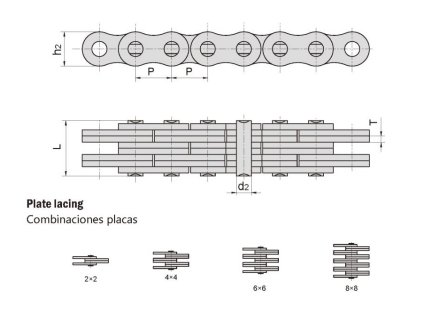
DIN/ISO
CHAIN NO. | Pitch | Plate
lacing | Plate
depth | Plate
thickness | Pin
diameter | Pin length | Ultimate
tensile
strength | Average
tensile
strength | Weight
per
meter |
DIN/ISO
Cadena
No | Paso | Combinación
placa | Altura
placas | Ancho
placas | Diámetro
pasador | Longitud
pasador | Resis.
rotura | Resis.
media
tracción | Peso
por
metro |
P |
| h2
max | T
max | d2
max | L
max | Q
min | Qo | q |
mm |
| mm | mm | mm | mm | kN/LB | kN | kg/m |
LL0822 | 12.700 | 2x2 | 10.6 | 1.6 | 4.45 | 8.9 | 18.2/4094 | 20.4 | 0.42 |
LL0844 | 4x4 | 15.6 | 36.4/8188 | 40.7 | 0.84 |
LL0866 | 6x6 | 22.0 | 54.6/12283 | 60.0 | 1.24 |
LL0888 | 8x8 | 28.5 | 72.8/16378 | 80.0 | 1.64 |
LL1022 | 15.875 | 2x2 | 13.7 | 1.6 | 5.08 | 9.2 | 22.7/5107 | 25.5 | 0.54 |
LL1044 | 4x4 | 15.8 | 45.4/10213 | 51.0 | 1.06 |
LL1066 | 6x6 | 22.1 | 68.1/15321 | 76.3 | 1.57 |
LL1088 | 8x8 | 28.8 | 90.8/20427 | 101.9 | 2.10 |
LL1222 | 19.050 | 2x2 | 16.0 | 1.85 | 5.72 | 10.4 | 29.5/6637 | 33.2 | 0.73 |
LL1244 | 4x4 | 17.9 | 59.0/13273 | 66.4 | 1.44 |
LL1266 | 6x6 | 25.4 | 88.5/19910 | 99.7 | 2.15 |
LL1288 | 8x8 | 32.9 | 118.0/26547 | 132.9 | 2.84 |
LL1622 | 25.40 | 2x2 | 21.00 | 3.1 | 8.28 | 17.2 | 58.0/13182 | 66.7 | 1.52 |
LL1644 | 4x4 | 29.6 | 116.0/26363 | 140.0 | 2.90 |
LL1666 | 6x6 | 42.4 | 174.0/39545 | 208.8 | 4.30 |
LL1688 | 8x8 | 54.9 | 232.0/52726 | 278.0 | 5.71 |
LL2022 | 31.75 | 2x2 | 26.40 | 3.5 | 10.19 | 20.1 | 95.0/21591 | 109.2 | 2.33 |
LL2044 | 4x4 | 33.8 | 190.0/43182 | 218.5 | 4.40 |
LL2066 | 6x6 | 50.1 | 285.0/64773 | 324.6 | 6.79 |
LL2088 | 8x8 | 64.0 | 380.0/86363 | 435.1 | 8.90 |
LL2422 | 38.10 | 2x2 | 33.40 | 5.0 | 14.63 | 28.4 | 170.0/38363 | 195.5 | 4.47 |
LL2444 | 4x4 | 46.3 | 340.0/77273 | 380.8 | 8.22 |
LL2466 | 6x6 | 66.4 | 510.0/115909 | 571.2 | 12.22 |
LL2488 | 8x8 | 86.6 | 680.0/154545 | 775.2 | 16.30 |
LL2822 | 44.45 | 2x2 | 37.08 | 6.0 | 15.90 | 32.2 | 200.0/45455 | 224.0 | 5.10 |
LL2844 | 4x4 | 56.4 | 400.0/90909 | 448.0 | 9.90 |
LL2866 | 6x6 | 80.8 | 600.0/136363 | 672.0 | 14.60 |
LL2888 | 8x8 | 105.2 | 800.0/181818 | 896.0 | 19.40 |
LL3222 | 50.80 | 2x2 | 42.00 | 6.4 | 17.81 | 34.8 | 260.0/59091 | 291.2 | 6.20 |
LL3244 | 4x4 | 60.6 | 520.0/118182 | 582.4 | 12.30 |
LL3266 | 6x6 | 86.4 | 780.0/177272 | 873.6 | 18.30 |
LL3288 | 8x8 | 112.2 | 1040.0/233970 | 1176.0 | 24.00 |
LL4022 | 63.50 | 2x2 | 52.76 | 8.0 | 22.89 | 42.2 | 360.0/81818 | 403.2 | 10.30 |
LL4044 | 4x4 | 74.4 | 780.0/177273 | 873.6 | 20.00 |
LL4066 | 6x6 | 106.5 | 1080.0/245454 | 1209.6 | 30.00 |
LL4088 | 8x8 | 140.0 | 1440.0/323959 | 1747.2 | 39.10 |
LL4822 | 76.20 | 2x2 | 63.88 | 10.0 | 29.24 | 54.6 | 560.0/127272 | 627.2 | 18.50 |
LL4844 | 4x4 | 92.6 | 1120.0/254545 | 1554.4 | 35.70 |
LL4866 | 6x6 | 133.4 | 1680.0/377953 | 1880.0 | 53.00 |
LL4888 | 8x8 | 174.2 | 2240.0/509091 | 2508.8 | 70.40 |
FAQ: Frequently Asked Questions
Q: What is the difference between LL Series and BL Series leaf chains?
A: LL Series (European Standard) is based on the ISO 4347 standard and uses plates and pins equivalent to the same pitch of roller chain. BL Series (Heavy Duty/American Standard) uses thicker plates and larger diameter pins, providing higher tensile strength for a given pitch.
Q: Can I replace a 2x2 lacing with a 4x4 lacing to increase strength?
A: While a 4x4 lacing is stronger, it is also much wider. You must ensure that your sheaves and anchor pins are wide enough to accommodate the larger profile and that the increased weight does not affect your equipment's balance.
Q: How often should I lubricate my forklift mast chain?
A: In standard indoor warehouse environments, we recommend a thorough lubrication every 250 hours of operation. In harsh, dusty, or outdoor environments, this should be increased to every 50 to 100 hours.
Q: Is it safe to repair a leaf chain link by link?
A: No. Unlike roller chains, leaf chains should never be repaired by replacing individual links or pins. If any part of a leaf chain is damaged or worn, the entire length must be replaced to ensure uniform strength and safety.
Would you like me to generate a "Visual Inspection Checklist" for your maintenance teams to help them identify early signs of leaf chain fatigue?

 English
  Español
  العربية
  Français
  Русский
  Português
  Deutsch
  italiano
  日本語
日本語  한국어
한국어  Nederlands
  Tiếng Việt
  ไทย
ไทย  Polski
  Türkçe
  አማርኛ
አማርኛ  ພາສາລາວ
  ភាសាខ្មែរ
  Bahasa Melayu
  ဗမာစာ
ဗမာစာ  தமிழ்
தமிழ்  Filipino
  Bahasa Indonesia
  magyar
  Română
  Čeština
  Монгол
  қазақ
қазақ  Српски
  हिन्दी
  فارسی
فارسی  Kiswahili
  Slovenčina
  Slovenščina
  Norsk
Norsk  Svenska
  українська
  Ελληνικά
  Suomi
Suomi  Հայերեն
  עברית
עברית  Latine
  Dansk
Dansk  اردو
اردو  Shqip
Shqip  বাংলা
বাংলা  Hrvatski
  Afrikaans
  Gaeilge
  Eesti keel
  Māori
Māori  සිංහල
සිංහල  नेपाली
  Oʻzbekcha
  latviešu
  অসমীয়া
  Aymara
  Azərbaycan dili
  Bamanankan
  Euskara
  Беларуская мова
  भोजपुरी


