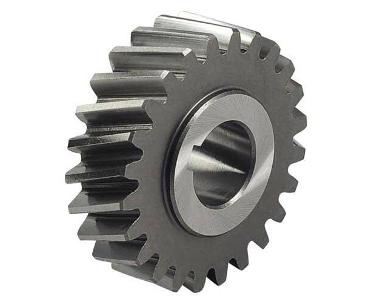
Helical Gears
PLW or Made to order
Carbon Steel
for Free
Plastic Bag+Carton Box+Plywood Case
Helical Gears
PLW
CHINA
Helical Gears
Helical Gears
| Availability: | |
|---|---|
| Quantity: | |
Core Principle: Cylindrical gears with spiral tooth lines; meshing occurs via progressive contact (instead of instantaneous contact in spur gears), reducing impact loads and suitable for power transmission between parallel shafts.
Key Types:
Right-hand Helical Gear: Tooth lines spiral upward to the right, most widely used.
Left-hand Helical Gear: Tooth lines spiral upward to the left, must be paired with right-hand gears.
Herringbone Gear: Symmetrically composed of left and right spiral teeth, eliminating axial forces, ideal for heavy-load, high-speed applications (e.g., marine propulsion systems).
| Parameter | Definition |
|---|---|
| Module (m) | Ratio of circular pitch to π; standard industrial values range from 1-20mm, determining gear size and load capacity. |
| Pressure Angle (α) | Standard value 20° (14.5° optional for low-noise requirements), affecting meshing smoothness and force transmission efficiency. |
| Helix Angle (β) | Angle between tooth line and gear axis; common range 8°-20° (larger β = higher load capacity but greater axial force). |
| Number of Teeth (z) | Total number of teeth on the gear, directly related to gear ratio (i = z₂/z₁), typically 12-60 teeth. |
| Face Width (b) | Axial width of the gear, balancing strength and installation space; generally 8-15 times the module. |
| Profile Shift Coefficient (x) | Used to optimize tooth contact, avoid undercutting, and enhance load capacity (positive shift increases tooth thickness; negative shift decreases it). |
Core Advantages:
Smooth meshing and low noise (progressive contact reduces impact);
30%-50% higher load capacity than spur gears (larger tooth contact area);
Compact structure, enabling larger gear ratios in limited space.
Typical Applications:
Industrial Machinery: Gearboxes, conveyors, compressors, machine tool spindles;
Automotive Sector: Transmissions, drive axles, engine timing systems;
General Machinery: Fans, pumps, reducers;
High-End Equipment: Robot joints, aerospace transmission components.
Common Materials:
Steel: 20CrMnTi (carburized and quenched, for heavy loads), 45# steel (quenched and tempered, for medium loads);
Cast Iron: HT200 (for low-speed, light-load scenarios, cost-effective);
Non-Metallic Materials: Nylon, POM (for low-noise, lubrication-free applications).
International Standards:
ISO 6336 (Gear load capacity calculation standard);
AGMA 2001 (American Gear Manufacturers Association standard);
DIN 3990 (German standard for helical gear geometric accuracy);
GB/T 10095 (Chinese standard for helical gear accuracy).
| Comparison Item | Helical Gear | Spur Gear |
|---|---|---|
| Meshing Method | Progressive contact, low impact | Instantaneous contact, high impact |
| Noise Level | Low | High |
| Load Capacity | High | Medium |
| Axial Force | Exists (thrust bearings required) | None |
| Manufacturing Difficulty | Higher (specialized machine tools needed) | Lower (simple processing) |
Core Principle: Cylindrical gears with spiral tooth lines; meshing occurs via progressive contact (instead of instantaneous contact in spur gears), reducing impact loads and suitable for power transmission between parallel shafts.
Key Types:
Right-hand Helical Gear: Tooth lines spiral upward to the right, most widely used.
Left-hand Helical Gear: Tooth lines spiral upward to the left, must be paired with right-hand gears.
Herringbone Gear: Symmetrically composed of left and right spiral teeth, eliminating axial forces, ideal for heavy-load, high-speed applications (e.g., marine propulsion systems).
| Parameter | Definition |
|---|---|
| Module (m) | Ratio of circular pitch to π; standard industrial values range from 1-20mm, determining gear size and load capacity. |
| Pressure Angle (α) | Standard value 20° (14.5° optional for low-noise requirements), affecting meshing smoothness and force transmission efficiency. |
| Helix Angle (β) | Angle between tooth line and gear axis; common range 8°-20° (larger β = higher load capacity but greater axial force). |
| Number of Teeth (z) | Total number of teeth on the gear, directly related to gear ratio (i = z₂/z₁), typically 12-60 teeth. |
| Face Width (b) | Axial width of the gear, balancing strength and installation space; generally 8-15 times the module. |
| Profile Shift Coefficient (x) | Used to optimize tooth contact, avoid undercutting, and enhance load capacity (positive shift increases tooth thickness; negative shift decreases it). |
Core Advantages:
Smooth meshing and low noise (progressive contact reduces impact);
30%-50% higher load capacity than spur gears (larger tooth contact area);
Compact structure, enabling larger gear ratios in limited space.
Typical Applications:
Industrial Machinery: Gearboxes, conveyors, compressors, machine tool spindles;
Automotive Sector: Transmissions, drive axles, engine timing systems;
General Machinery: Fans, pumps, reducers;
High-End Equipment: Robot joints, aerospace transmission components.
Common Materials:
Steel: 20CrMnTi (carburized and quenched, for heavy loads), 45# steel (quenched and tempered, for medium loads);
Cast Iron: HT200 (for low-speed, light-load scenarios, cost-effective);
Non-Metallic Materials: Nylon, POM (for low-noise, lubrication-free applications).
International Standards:
ISO 6336 (Gear load capacity calculation standard);
AGMA 2001 (American Gear Manufacturers Association standard);
DIN 3990 (German standard for helical gear geometric accuracy);
GB/T 10095 (Chinese standard for helical gear accuracy).
| Comparison Item | Helical Gear | Spur Gear |
|---|---|---|
| Meshing Method | Progressive contact, low impact | Instantaneous contact, high impact |
| Noise Level | Low | High |
| Load Capacity | High | Medium |
| Axial Force | Exists (thrust bearings required) | None |
| Manufacturing Difficulty | Higher (specialized machine tools needed) | Lower (simple processing) |