Views: 0 Author: Site Editor Publish Time: 2026-08-30 Origin: Site


Selecting the wrong roller chain doesn't just cause premature wear. It leads to catastrophic equipment failure, unplanned downtime, and inflated maintenance budgets. Industrial drive systems demand precise component matching to operate safely. When you choose an inadequate chain, you risk destroying critical machinery.
While these components appear simple, matching the correct specification to dynamic operational loads requires rigorous engineering evaluation. Many procurement teams rely solely on standard catalog dimensions. They overlook the operational realities of shock loads, environmental hazards, and continuous cyclical stress. An under-specced chain breaks quickly under tension. An over-specced chain adds unnecessary mass and accelerates sprocket wear.
We will introduce the exact decision framework required to evaluate and shortlist the right chain system for specific industrial environments. You will learn how to decode technical metrics accurately. We will also explore the trade-offs of heavy-duty components and show you how to evaluate supplier credibility effectively.
Engineers often approach chain selection by looking at dimensional fit first. True reliability starts by defining the core operational intent. You must distinguish between drive applications and conveyor applications before calculating any numbers. Power transmission drives typically operate at higher speeds. They require continuous tension and smooth engagement. Conveyor applications operate at lower speeds but handle massive variable weights. Material handling also heavily relies on custom attachments for moving products.
Once you define the application type, you must evaluate the foundational engineering metrics. Reviewing baseline data correctly prevents early design failures. When analyzing roller chains specifications, you should prioritize three critical calculations.
Understanding these three metrics creates a reliable engineering baseline. You can then confidently eliminate chains incapable of surviving your baseline mechanical stress.
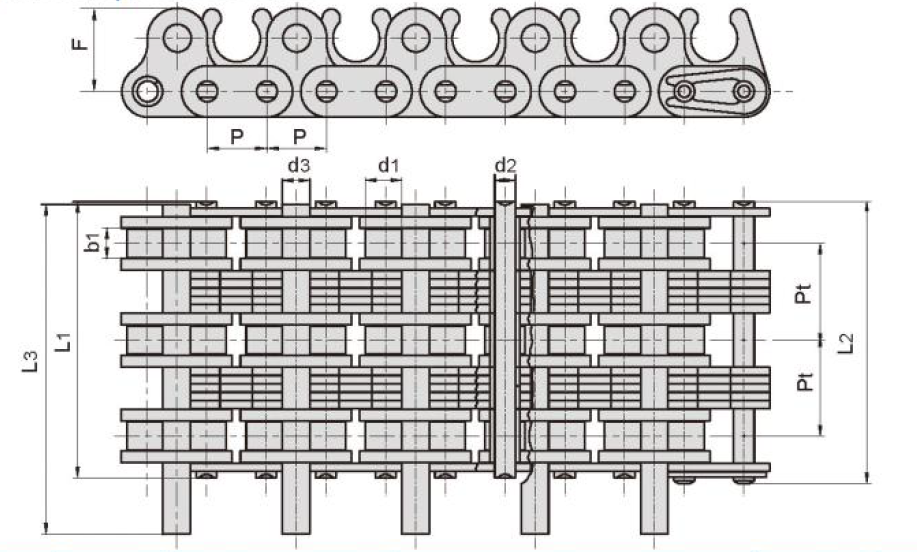
Many maintenance teams assume upgrading to a heavy-duty option automatically solves frequent breakage issues. This assumption creates new mechanical problems. You must evaluate standard and heavy-duty series as distinct solution categories. Each option carries specific engineering trade-offs.
Standard series chains provide excellent performance for uniform loads. They excel in high-speed applications. When weight constraints or spatial footprints dictate design limits, standard chains offer the best balance. They flex easily and maintain lower inertial mass during rapid acceleration.
Heavy-duty series utilize thicker link plates. Manufacturers typically use the plate thickness of the next larger pitch size. This design choice dramatically increases resistance to fatigue and shock loads. It prevents the side plates from stretching under sudden tension spikes. However, this upgrade introduces significant implementation risks.
| Application Profile | Recommended Series | Primary Justification |
|---|---|---|
| High-speed packaging lines | Standard Series | Requires low mass, high flexibility, and handles uniform loads efficiently. |
| Agricultural harvesting equipment | Heavy-Duty Series | Demands extreme shock load resistance during field debris jams. |
| Precision robotic indexing | Standard Series | Prioritizes minimal vibration and precise spatial routing. |
| Mining and heavy material conveyors | Heavy-Duty Series | Requires thick plates to survive constant high-tension starting torque. |
You must map your specific operational risk profile against this matrix. Upgrading components unnecessarily wastes budget and harms system efficiency. Standard roller chains often perform flawlessly when properly matched to uniform power transmission duties.
Standard catalog specifications assume a controlled, clean operating environment. Industrial realities rarely match this ideal. When you evaluate niche applications, the ambient environment overrides basic load calculations. You must adapt your selection to specific industry hazards to demonstrate true engineering expertise.
The textile industry presents one of the most demanding environments for drive systems. Cleanliness is an absolute imperative. You cannot rely on standard heavy lubrication protocols. Wet grease attracts airborne fibers, lint, and dust. This creates an abrasive paste. It accelerates pin wear and causes immediate joint freezing. Furthermore, any oil dripping from the drive system ruins the manufactured fabric, resulting in massive scrap costs.
To solve this, engineers specify specialized roller chains for textile machinery. These variations utilize self-lubricating sintered oil-impregnated bushings. They release microscopic amounts of lubrication only when the joint flexes. Nickel-plated finishes also prevent corrosion from factory humidity without requiring external rust-preventative oils. These clean-running solutions protect the product while maintaining drive integrity.
Precision indexing adds another layer of complexity. Textile looms, commercial printing presses, and automated assembly lines require perfect synchronization. As components run, the internal pins and bushings wear down. This internal wear manifests as elongation, commonly called chain stretch. In precision environments, even a one percent stretch destroys machine timing. This leads to broken yarns, misaligned print colors, or jammed robotics.
You must mitigate this risk proactively. Pre-stretched chains undergo heavy loading during the manufacturing process. This seats the internal components firmly, eliminating initial run-in elongation. Specialized low-wear chains utilizing hardened pins or solid bushings drastically slow the elongation curve. Selecting these precision variants guarantees your machinery maintains critical timing over a much longer lifecycle.
Procuring a premium, highly engineered chain solves only half the problem. The most common adoption risk occurs during installation. Operators frequently buy top-tier components and ruin them instantly by pairing them with bad sprockets. You must view the chain and sprocket as an integrated system. They share forces, friction, and operational wear equally.
The mismatch penalty is severe. When a sprocket wears down, the tooth profile changes. The gaps between teeth widen, and a hooked shape develops. If you install a brand-new chain onto this worn profile, the pitch no longer aligns correctly. Instead of distributing the drive load across multiple teeth, the worn sprocket concentrates the entire load onto a single tooth and a single roller. This extreme localized stress accelerates wear by up to 50 percent. A system expected to last three years might fail in six months.
Sprocket selection criteria dictate system longevity just as much as chain specifications. You must insist on hardened teeth for high-wear applications or abrasive environments. Induction-hardened teeth resist the constant impact of steel rollers much better than unhardened mild steel.
Correct tooth count also plays a critical role in system dynamics. Low tooth counts cause a phenomenon known as the polygonal effect, or chordal action. As the chain wraps around a small sprocket, it does not form a perfect circle. It forms a polygon. This causes the pitch line velocity to rise and fall with every tooth engagement. The resulting vibration travels through the shafts and destroys bearings. For high-speed drives, you should always avoid low tooth counts. Specify sprockets with at least 17 teeth, ideally 21 or more, to minimize vibration and ensure smooth power transmission.
Moving from product specification to vendor selection requires a shift in evaluation criteria. Standard off-the-shelf options rarely suffice for complex B2B applications. You must assess the credibility and technical capabilities of the vendor. Buying a commodity part is entirely different from securing a reliable engineering partnership.
Complex drive systems often demand customization. You need a partner capable of modifying standard designs. Assess whether the vendor provides specific OEM support. Do they offer custom attachment links for your material handling layout? Can they apply specialized platings for corrosive washdown environments? Do they provide exact cut-to-length services to eliminate labor-intensive field splicing? A capable roller chains supplier will manage these modifications in-house to guarantee structural integrity.
Verification and compliance separate premium suppliers from unreliable brokers. You must advise your procurement team to demand documented compliance. Look for strict adherence to ISO, DIN, or ANSI manufacturing standards. These frameworks ensure dimensional accuracy and predictable performance.
Ask the supplier for traceable material certifications. You need proof verifying the carbon content and heat-treatment processes of the steel used. Furthermore, investigate their in-house testing capabilities. Reputable manufacturers perform continuous fatigue testing and tensile verification on every production batch. They do not guess at their performance limits; they prove them in a laboratory setting.
Before placing an order, gather your operational parameters. Document your continuous torque, peak shock loads, rotational RPM, and environmental conditions. Take this data directly to the supplier's application engineers. Ask them for a validated recommendation. A trustworthy vendor will review your calculations, challenge your assumptions, and propose a solution backed by hard data.
Optimal drive system performance relies entirely on precise engineering alignment. Selecting the right components requires balancing dimensional specifications, environmental adaptations, and total system compatibility. You must look past basic tensile strength and evaluate actual fatigue limits and operational shock loads.
Avoid applying heavy-duty solutions blindly. Always weigh the benefits of thicker plates against the realities of added mass and reduced lateral flexibility. Remember to treat sprockets and chains as a unified ecosystem. Replacing one without assessing the other guarantees premature mechanical failure. Furthermore, leverage specialized designs for harsh or high-precision environments to protect your end product.
Take proactive control of your equipment reliability today. Gather your current drive parameters, including operating speeds, load spikes, and environmental hazards. Contact an experienced engineering team for a comprehensive selection audit. Request a quote on specialized OEM solutions tailored precisely to your operational realities.
A: The acceptable wear limit typically ranges from 1.5% to 3% depending on the specific application. The sprocket tooth count dictates the exact tolerance before skipping occurs. High-precision systems require replacement closer to 1.5%, while simpler drives may tolerate up to 3% stretch before failure.
A: Generally, no. Heavy-duty chains feature thicker link plates, which change the overall width and transverse pitch clearance. Running a standard chain on a heavy-duty sprocket, or vice versa, leads to severe misalignment. This guarantees rapid wear, system binding, and potential derailment during operation.
A: Standard carbon steel components lose strength at high temperatures and become dangerously brittle in sub-zero conditions. You must specify stainless steel alloys for extreme environments. Additionally, specialized high-temp lubricants or solid-lubricant bushings are necessary, as standard grease degrades or freezes outside normal operating ranges.


