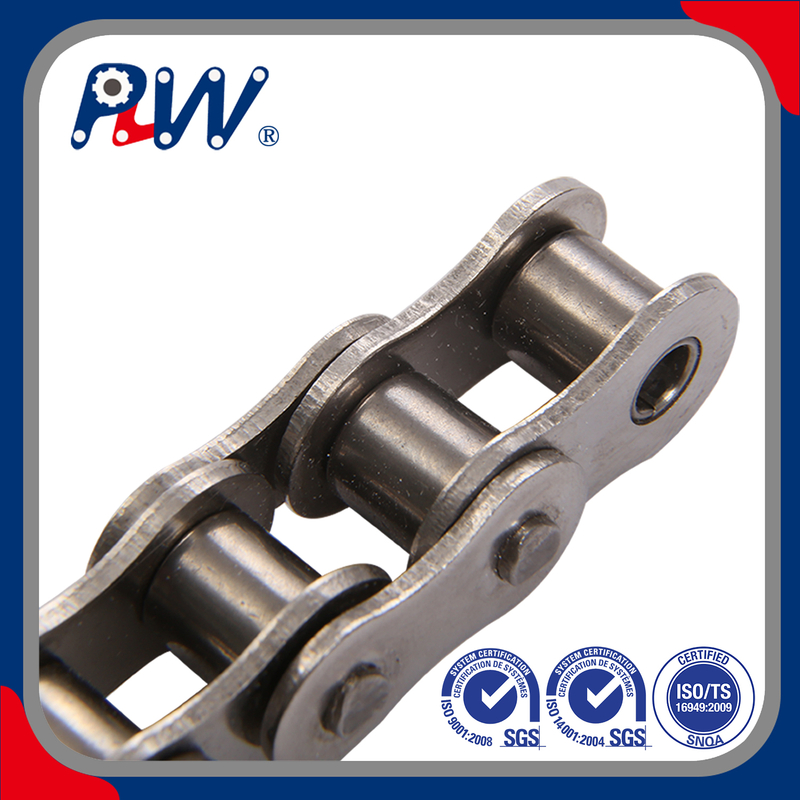
Product Description
Imagine a production floor where the air is humid, scented with cleaning agents, and the machinery is constantly subjected to high-pressure water jets. In this environment, a standard carbon steel chain is a liability—a ticking clock of rust and downtime. Our Stainless Steel Roller Chains are designed to be the antidote to that stress. When you run your hand across our links, you don't feel the greasy, heavy residue of industrial oil. Instead, you feel the smooth, cool, and pristine surface of surgical-grade steel. It is a product that looks as clean as the facility it serves, reflecting light with a satin finish that signals pure mechanical quality.
We were inspired by the daily battles of the food and beverage industry, where the margin for error is zero and the cost of contamination is catastrophic. This chain isn't just about moving a belt; it's about the silence of a perfectly articulated drive system and the rhythmic "click" of precision-ground rollers meeting their sprockets without a hint of friction. By switching to our stainless steel series, you are choosing a silent partner that won't flake, won't rust, and won't compromise your product's purity. It turns a high-maintenance headache into a "set-and-forget" asset, allowing you to focus on your throughput while we handle the harsh chemistry of your environment.
Product Features and Highlights
The core value of our stainless steel series lies in its specialized metallurgical properties and manufacturing precision:
Certified 304/316 Grade Alloys: We use only verified raw materials. Grade 304 offers excellent general corrosion resistance, while Grade 316 is optimized for high-chloride or marine environments where acid resistance is a critical requirement.
Fully Seamless Roller Construction: Unlike folded rollers that can harbor bacteria in their seams, our rollers are cold-drawn and seamless. This prevents the buildup of organic matter and makes high-pressure steam cleaning 100% effective.
Vacuum-Heat Treatment: Our components undergo heat treatment in a vacuum environment to ensure that the protective chromium oxide layer remains intact. This maximizes the chain's ability to "self-heal" its surface after minor abrasions.
Non-Magnetic Properties: For sensitive electronics manufacturing or pharmaceutical sorting lines, our 316-grade chains offer non-magnetic operation, preventing interference with delicate sensors and instrumentation.
Material Selection & Environmental Adaptation
Choosing the right stainless steel grade is essential for the longevity of your system. Our E-E-A-T focused engineering team helps you match the material to the chemical reality of your production floor.
Grade 304 (Standard Stainless): The most popular choice for food packaging and bottling. It provides exceptional resistance to water and mild detergents. It is the cost-effective "gold standard" for hygiene.
Grade 316 (Acid-Resistant): Essential for meat processing (where salt is prevalent) or chemical plants. The addition of molybdenum makes it immune to the "pitting" corrosion caused by chlorides and industrial acids.
Grade 600 Series (Hardened Stainless): For applications requiring the corrosion resistance of stainless but the wear life closer to carbon steel. This material undergoes precipitation hardening, making the pins significantly more resistant to elongation.
Temperature Resilience: Our chains operate comfortably from -40°C in flash freezers up to +400°C in industrial ovens, maintaining their structural integrity and tensile strength throughout the thermal cycle.
Manufacturing Excellence & Quality Control
We understand that in the pharmaceutical and food industries, "good enough" is never an option. Our manufacturing process is a rigorous series of checks designed to ensure absolute reliability.
Precision Centerless Grinding: The pins and bushes are ground to a mirror finish. This reduces the initial "break-in" wear and ensures that the chain maintains its pitch accuracy even in the absence of heavy lubrication.
Automated Link Assembly: Using high-speed Swiss-engineered assembly lines, we ensure that every riveting point is identical. This eliminates the "stiff links" that cause vibration and premature sprocket wear.
Nitric Acid Passivation: Every chain undergoes a chemical passivation process that removes any surface impurities and thickens the protective oxide layer, significantly boosting its anti-rust performance.
Pre-Loading Protocol: We apply a rigorous pre-stretch to every chain before shipping. This stabilizes the internal components, ensuring that your automated indexing remains perfectly synchronized from the first hour of operation.
Application Use-Cases for Critical Environments
Our Stainless Steel Roller Chains are the trusted choice for industries where traditional drive systems fail due to environmental stress.
Industrial Bakeries: Navigating high-heat proofers and ovens where grease-based lubricants cannot be used due to smoke and contamination risks.
Pharmaceutical Labs: Operating in cleanrooms for vaccine packaging and pill sorting where particulate matter and magnetism must be strictly controlled.
Seafood & Meat Processing: Standing up to the high-salinity and high-moisture environments that would corrode a standard chain within weeks.
Chemical Synthesis: Moving materials through acidic wash-baths and sterilization tunnels where standard metals would undergo rapid oxidation.
Technical Specifications & Parameter Table
Our Stainless Steel Roller Chains are available in both ANSI (American Standard) and BS/DIN (British/European Standard). These parameters represent the precision tolerance required for seamless integration into high-speed automation.
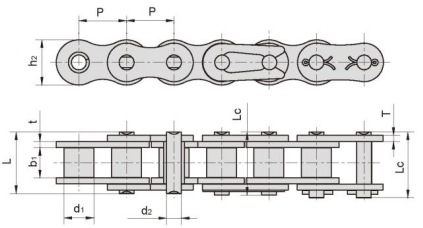
| CHAIN NO. | Pitch | Roller
diameter | between
inner plates | Pin
diameter | Pin length | Inner
Plate
depth | Plate
thickness | Breaking
load | Weight
per
meter |
| Cadena No | Paso | Diámetro
rodillo | Ancho
interior | Diámetro
pasador | Longitud
pasador | Altura
placas | Ancho
placas | Carga
rotura | Peso
por
metro |
| P | d1
max | b1
min | d2
max | L
max | Lc
max | h2
max | t/T
max | Q | q |
| mm | mm | mm | mm | mm | mm | mm | mm | kN/LB | kg/m |
| *25SS | 6.350 | 3.30 | 3.18 | 2.31 | 7.9 | 8.40 | 6.00 | 0.80 | 2.5/568 | 0.15 |
| *35SS | 9.525 | 5.08 | 4.77 | 3.58 | 12.4 | 13.17 | 9.00 | 1.30 | 5.5/1250 | 0.33 |
| 40SS | 12.700 | 7.95 | 7.85 | 3.96 | 16.6 | 17.80 | 12.00 | 1.50 | 9.6/2182 | 0.63 |
| 41SS | 12.700 | 7.77 | 6.25 | 3.58 | 13.75 | 15.00 | 9.91 | 1.30 | 6.0/1360 | 0.46 |
| 50SS | 15.875 | 10.16 | 9.40 | 5.08 | 20.7 | 22.20 | 15.09 | 2.03 | 15.2/3455 | 1.03 |
| 60SS | 19.050 | 11.91 | 12.57 | 5.94 | 25.9 | 27.70 | 18.00 | 2.42 | 21.7/4932 | 1.51 |
| 80SS | 25.400 | 15.88 | 15.75 | 7.92 | 32.7 | 35.00 | 24.00 | 3.25 | 38.9/8841 | 2.62 |
| 100SS | 31.750 | 19.05 | 18.90 | 9.53 | 40.4 | 44.70 | 30.00 | 4.00 | 60.0/13636 | 3.94 |
| 120SS | 38.100 | 22.23 | 25.22 | 11.10 | 50.3 | 54.30 | 35.70 | 4.80 | 72.5/16477 | 5.72 |
| 140SS | 44.450 | 25.40 | 25.22 | 12.70 | 54.4 | 59.00 | 41.0 | 5.60 | 94.0/21363 | 7.70 |
| 04BSS | 6.000 | 4.00 | 2.80 | 1.85 | 6.80 | 7.80 | 5.00 | 0.60 | 2.0/455 | 0.11 |
| 05BSS | 8.000 | 5.00 | 3.00 | 2.31 | 8.20 | 8.90 | 7.10 | 0.80 | 3.5/795 | 0.20 |
| #06BSS | 9.525 | 6.35 | 5.72 | 3.28 | 13.15 | 14.10 | 8.20 | 1.30 | 6.2/1409 | 0.41 |
| 08BSS | 12.700 | 8.51 | 7.75 | 4.45 | 16.7 | 18.20 | 11.80 | 1.60 | 12.0/2727 | 0.70 |
| 10BSS | 15.875 | 10.16 | 9.65 | 5.08 | 19.5 | 20.90 | 14.70 | 1.70 | 14.5/3295 | 0.94 |
| 12BSS | 19.050 | 12.07 | 11.68 | 5.72 | 22.5 | 24.20 | 16.00 | 1.85 | 18.5/4205 | 1.16 |
| 16BSS | 25.400 | 15.88 | 17.02 | 8.28 | 36.1 | 37.40 | 21.00 | 4.15/3.1 | 40.0/9091 | 2.73 |
| 20BSS | 31.750 | 19.05 | 19.56 | 10.19 | 41.3 | 45.00 | 26.40 | 4.5/3.5 | 59.0/13409 | 3.73 |
| 24BSS | 38.100 | 25.40 | 25.40 | 14.63 | 53.4 | 57.80 | 33.20 | 6.0/4.8 | 104.0/25454 | 7.20 |
| 32BSS | 50.800 | 29.21 | 30.99 | 17.81 | 66.0 | 71.00 | 42.00 | 7.0/6.0 | 150.0/34090 | 10.22 |
FAQ: Frequently Asked Questions
Q: Is a stainless steel chain as strong as a carbon steel chain?
A: Generally, stainless steel chains have a lower tensile strength than high-carbon steel chains. However, in corrosive environments, a carbon steel chain loses its strength rapidly due to rust, whereas a stainless chain maintains its rated strength over a much longer lifecycle.
Q: Does a stainless steel chain need to be lubricated?
A: While stainless steel has better "dry-running" properties than carbon steel, we recommend using a food-grade H1 lubricant to minimize friction and wear. For applications where no lubricant is allowed, we offer specialized self-lubricating bushes.
Q: Which is better for a marine environment, 304 or 316?
A: Grade 316 is significantly better for marine or high-salinity environments. The molybdenum in 316 protects against "crevice corrosion" and salt-water pitting that will eventually damage 304.
Q: Can I use your stainless steel chain with standard iron sprockets?
A: You can, but it is not recommended for long-term use. To prevent "galvanic corrosion" and ensure the longest possible life for both components, we strongly recommend using stainless steel sprockets with your stainless chains.
Would you like me to help you draft a "Stainless Steel Grade Selection Guide" to assist your customers in choosing between 304 and 316 based on their specific chemical exposure?

 English
  Español
  العربية
  Français
  Русский
  Português
  Deutsch
  italiano
  日本語
日本語  한국어
한국어  Nederlands
  Tiếng Việt
  ไทย
ไทย  Polski
  Türkçe
  አማርኛ
አማርኛ  ພາສາລາວ
  ភាសាខ្មែរ
  Bahasa Melayu
  ဗမာစာ
ဗမာစာ  தமிழ்
தமிழ்  Filipino
  Bahasa Indonesia
  magyar
  Română
  Čeština
  Монгол
  қазақ
қазақ  Српски
  हिन्दी
  فارسی
فارسی  Kiswahili
  Slovenčina
  Slovenščina
  Norsk
Norsk  Svenska
  українська
  Ελληνικά
  Suomi
Suomi  Հայերեն
  עברית
עברית  Latine
  Dansk
Dansk  اردو
اردو  Shqip
Shqip  বাংলা
বাংলা  Hrvatski
  Afrikaans
  Gaeilge
  Eesti keel
  Māori
Māori  සිංහල
සිංහල  नेपाली
  Oʻzbekcha
  latviešu
  অসমীয়া
  Aymara
  Azərbaycan dili
  Bamanankan
  Euskara
  Беларуская мова
  भोजपुरी