1. Introduction
Ever wondered how power gets transferred between shafts at right angles? Bevel gears are the unsung heroes in this process. Whether in cars, planes, or industrial machinery, these gears are behind the scenes, making sure everything runs smoothly.
In this article, we'll dive into the four main types of bevel gears—straight, spiral, hypoid, and zerol—and explore how each one fits into different applications. Plus, we’ll compare them to other gears like the helical gear, so you can understand which gear works best for your needs.
2. What are Bevel Gears?
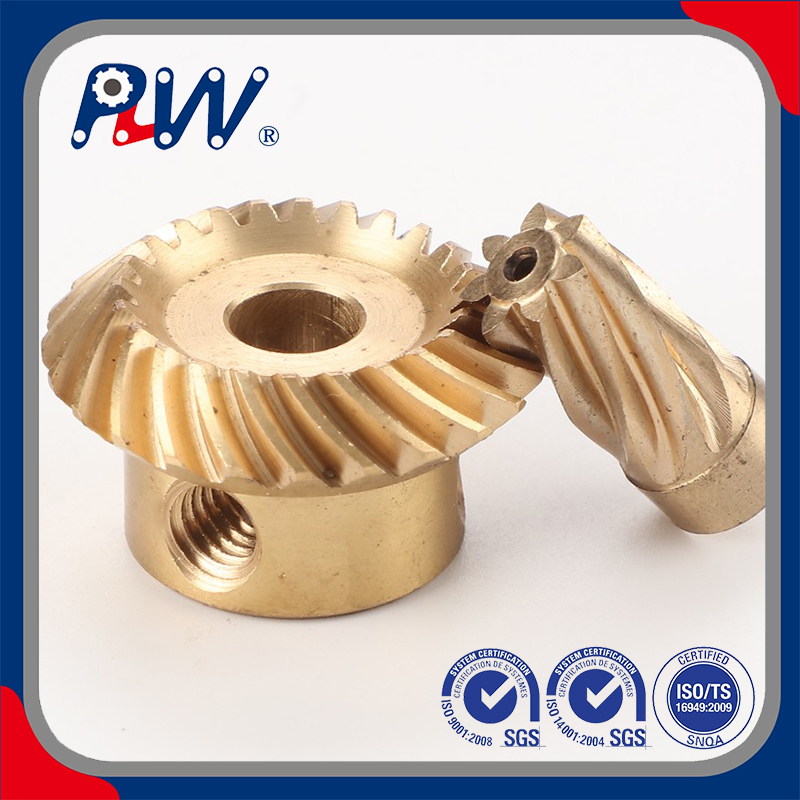
Bevel gears are specialized gears designed to transfer rotational motion between intersecting shafts, most commonly at a 90-degree angle. Unlike spur gears, which work on parallel shafts, bevel gears have a conical shape, with angled teeth that mesh progressively. This unique design allows bevel gears to handle high torque efficiently while enabling power transfer at different directions. The ability of bevel gears to transmit torque without causing significant vibrations or noise makes them ideal for a wide range of high-performance machinery, including automotive differentials and industrial equipment.
The teeth of bevel gears are generally cut at an angle relative to the axis of rotation, which allows the gears to engage at an angle, typically 90 degrees. This feature makes bevel gears highly effective in applications requiring changes in the direction of motion. Their robust design and efficient power transmission capabilities make them indispensable in many industries, where reliability under heavy loads and at high speeds is critical.
Bevel gears work by meshing teeth that are aligned at an angle, enabling a gradual transfer of power between the gears. This design minimizes impact loads, reducing wear and enhancing the overall lifespan of the gears. The smooth, progressive contact between the teeth is one of the reasons why bevel gears are known for their quiet operation, even under high load conditions. This characteristic is particularly important in industries where noise reduction is a priority.
3. Types of Bevel Gears
There are four main types of bevel gears: straight bevel, spiral bevel, hypoid, and zerol bevel gears. Each type of bevel gear is designed for specific applications based on factors such as load capacity, speed, noise, and efficiency. Here’s a detailed breakdown of each type:
● Straight Bevel Gears
Straight bevel gears have straight teeth cut along the radius of the cone, making them the simplest and most commonly used type of bevel gear. These gears are typically employed in low-speed applications where the torque requirements are not extreme. Their straightforward design makes them easy to manufacture and cost-effective, which is why they are a popular choice for basic machinery. However, one of their main drawbacks is that they can produce noisy operation at higher speeds due to the instantaneous contact between the teeth, which makes them less suitable for high-speed, high-performance applications where noise reduction is a priority. As a result, straight bevel gears are best used in low-speed machinery, where the cost is a concern, and noise is not a significant issue.
● Spiral Bevel Gears
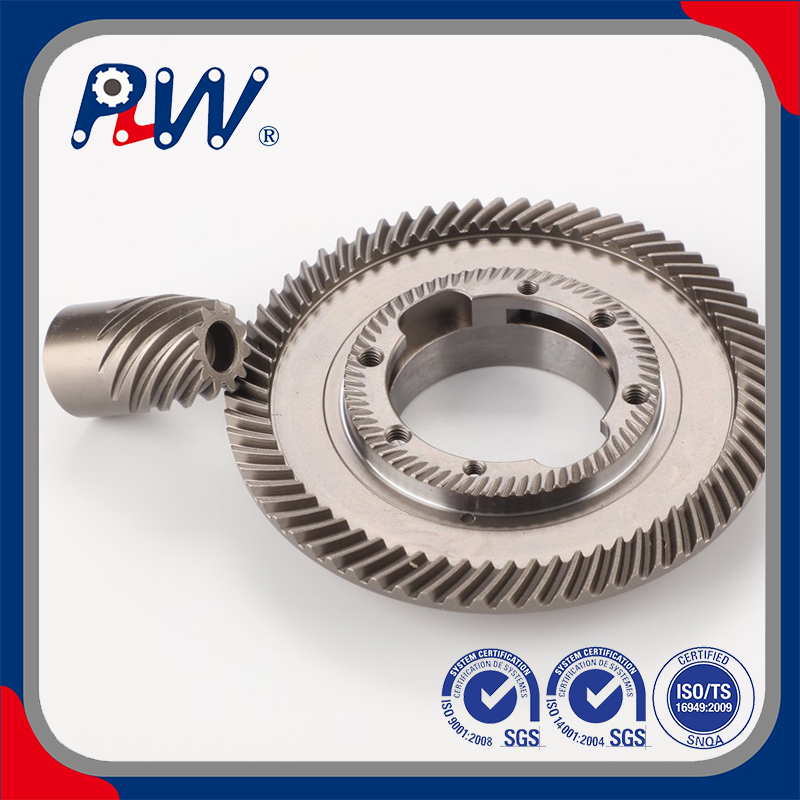
Spiral bevel gears have curved teeth that provide smoother and quieter operation compared to straight bevel gears. Their design allows for more contact between the gear teeth at any given time, which increases torque capacity and improves the efficiency of power transmission. This makes spiral bevel gears ideal for high-performance machinery such as automotive differentials and aircraft engines, where high speeds and heavy loads need to be handled with minimal noise. While spiral bevel gears offer superior performance in terms of noise reduction and torque handling, they are more complex to manufacture and require precise alignment, which increases their production costs. Despite the higher manufacturing expense, their advantages in performance often justify the cost in high-speed, high-performance applications where reduced noise and increased load capacity are critical.
● Hypoid Gears
Hypoid gears are a variation of spiral bevel gears, but with an offset between the axes of the two gears. This offset allows for a larger contact area, which improves torque capacity and reduces the risk of wear over time. Hypoid gears also offer a more compact design, which is ideal for applications where space is limited but high torque is still required. These gears are typically found in automotive differentials, heavy machinery, and industrial equipment. Despite their advantages, hypoid gears are more complex to design and manufacture than other bevel gears, requiring specialized equipment and expertise. Their ability to handle high torque and operate smoothly in compact spaces makes them indispensable in systems where space constraints are a concern, yet high torque transmission is necessary.
● Zerol Bevel Gears
Zerol bevel gears combine features of both spiral and straight bevel gears. They have curved teeth similar to spiral bevel gears but with a 0-degree spiral angle. This unique design eliminates axial forces, making zerol bevel gears ideal for applications that require noise reduction and high load capacity. These gears are commonly used in heavy-duty industrial machinery, robotics, and precision tools, where quiet operation and the ability to bear heavy loads are essential. The design of zerol bevel gears allows for excellent performance in noise-sensitive environments, but their more complex manufacturing process makes them more expensive than straight bevel gears. Despite the higher production costs, their ability to provide quiet operation while handling high torque and heavy loads makes them an excellent choice for high-load applications in industries such as robotics and aerospace.
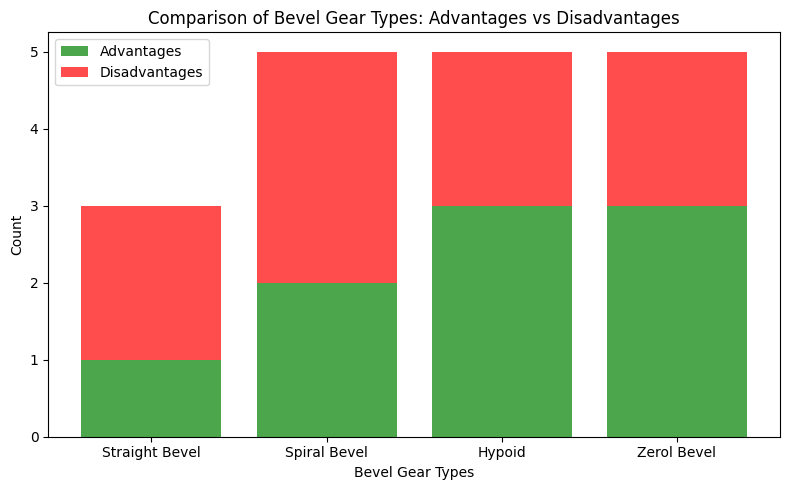
Gear Type | Advantages | Disadvantages | Typical Applications |
Straight Bevel | Simple design, low cost | Noisy at high speeds, limited torque | Basic machinery, light-duty applications |
Spiral Bevel | Quieter, higher torque capacity | Complex manufacturing, precise alignment | Automotive differentials, aerospace |
Hypoid | High torque, compact design | Higher manufacturing cost, alignment needed | Automotive differentials, heavy machinery |
Zerol Bevel | Noise reduction, high load-bearing capacity | Less efficient than spiral gears | High-load industrial machinery, robotics |
4. Choosing the Right Bevel Gear for Your Application
When selecting a bevel gear for a particular application, there are several important factors to consider. These include the torque and speed requirements, the available space in the system, the type of load the gear will need to handle, and the desired noise level. Each type of bevel gear has specific advantages and limitations depending on these factors, so understanding the characteristics of each gear type is essential for making an informed decision.
Shaft angle plays a crucial role in determining the type of bevel gear needed for the application. Bevel gears are most effective when used at a 90-degree angle, but they can also be used at other angles depending on the application’s needs. The size and space constraints of the system should also be considered, as bevel gears work well in compact designs but need to fit within the available space.
The load and speed requirements of the application are critical factors in gear selection. For high-torque applications, hypoid gears may be the best choice due to their higher torque transmission capacity. For applications where speed is a concern, spiral bevel gears are preferred for their ability to operate at high speeds with reduced noise. Additionally, the axial forces generated by certain types of bevel gears, such as spiral bevel and zerol bevel gears, should be taken into account when selecting the appropriate bearings and supporting structures.
Manufacturing costs also play a role in selecting bevel gears. Straight bevel gears are the least expensive to manufacture due to their simple design and production process. Spiral and hypoid bevel gears, however, require more complex manufacturing techniques and higher precision, which increases their cost. While they offer superior performance, the added cost may not always be justified in low-speed or low-torque applications.
5. Advantages and Disadvantages of Bevel Gears
Bevel gears are widely used for their ability to transfer power efficiently between intersecting shafts. However, like all gear types, they come with their own set of advantages and disadvantages. The main advantage of bevel gears is their ability to transfer torque at right angles, making them ideal for applications where directional changes are necessary. Bevel gears are compact, making them suitable for use in systems with limited space. Their ability to handle heavy loads makes them essential in many industrial applications, including heavy machinery and automotive systems.
One of the key disadvantages of bevel gears is the complexity involved in their manufacturing process. Spiral and hypoid bevel gears, in particular, require more precision and specialized equipment, which increases the cost of production. Furthermore, bevel gears—especially spiral bevel and zerol bevel gears—require precise alignment to function optimally. Improper installation or alignment can result in inefficient power transmission and premature wear.
The axial forces generated by spiral bevel and hypoid gears require the use of thrust bearings to handle these forces and ensure smooth operation. Additionally, bevel gears can be noisy at high speeds, especially straight bevel gears, which engage their teeth instantaneously rather than progressively. This is less of a problem with spiral and hypoid bevel gears, which are designed to operate more smoothly at high speeds.
6. Conclusion
Bevel gears are indispensable components in many mechanical systems where power needs to be transferred between intersecting shafts. Understanding the different types of bevel gears—straight, spiral, hypoid, and zerol—helps engineers select the most suitable gear for specific applications, optimizing the performance, noise level, and load capacity of machinery. While bevel gears are essential in heavy-duty applications requiring a change in direction, helical gears provide a smoother alternative for parallel-shaft systems. By carefully considering the load, speed, and space constraints of the system, engineers can choose the right bevel gear to improve the efficiency and longevity of their equipment. Companies like Hangzhou Perpetual Machinery & Equipment Co., Ltd. provide high-quality bevel gears tailored to meet the specific needs of various industries, ensuring optimal performance and reliability in every application.
FAQ
Q: What are bevel gears used for?
A: Bevel gears are used to transmit power between shafts that intersect at an angle, typically 90 degrees. They are essential in machinery like automotive differentials and gearboxes, where a direction change in the power flow is required.
Q: What is the difference between bevel gears and helical gears?
A: Bevel gears transfer power between intersecting shafts at angles, while helical gears operate on parallel shafts. Helical gears offer smoother and quieter operation, whereas bevel gears are designed for applications requiring a change in direction.
Q: Why are spiral bevel gears preferred in high-performance applications?
A: Spiral bevel gears provide smoother and quieter operation than straight bevel gears due to their curved teeth. This makes them ideal for high-speed, high-load applications, such as automotive differentials, where performance and noise reduction are key.
Q: What is a hypoid bevel gear?
A: Hypoid bevel gears are similar to spiral bevel gears but with an offset between the axes of the two gears. This design increases torque capacity and provides a more compact configuration, making them ideal for automotive differentials and heavy machinery.
Q: How do zerol bevel gears differ from spiral bevel gears?
A: Zerol bevel gears have curved teeth like spiral bevel gears but with a 0-degree spiral angle, eliminating axial forces. This makes them ideal for applications requiring noise reduction and high load capacity, such as heavy-duty industrial machinery and robotics.

 Español
  English
  العربية
  Français
  Русский
  Português
  Deutsch
  italiano
  日本語
日本語  한국어
한국어  Nederlands
  Tiếng Việt
  ไทย
ไทย  Polski
  Türkçe
  አማርኛ
አማርኛ  ພາສາລາວ
  ភាសាខ្មែរ
  Bahasa Melayu
  ဗမာစာ
ဗမာစာ  தமிழ்
தமிழ்  Filipino
  Bahasa Indonesia
  magyar
  Română
  Čeština
  Монгол
  қазақ
қазақ  Српски
  हिन्दी
  فارسی
فارسی  Kiswahili
  Slovenčina
  Slovenščina
  Norsk
Norsk  Svenska
  українська
  Ελληνικά
  Suomi
Suomi  Հայերեն
  עברית
עברית  Latine
  Dansk
Dansk  اردو
اردو  Shqip
Shqip  বাংলা
বাংলা  Hrvatski
  Afrikaans
  Gaeilge
  Eesti keel
  Māori
Māori  සිංහල
සිංහල  नेपाली
  Oʻzbekcha
  latviešu
  অসমীয়া
  Aymara
  Azərbaycan dili
  Bamanankan
  Euskara
  Беларуская мова
  भोजपुरी


