A roller chain may look simple, but its parts have specific names. Those names often appear only in technical drawings, catalogs, and maintenance work. In this article, we will cover the main roller chain parts, how they form links, which connection pieces are commonly named, and how these terms are used in identification.
What are the main parts of a roller chain?
A standard roller chain is built from a small set of precision components that repeat in a consistent pattern. Although the chain looks like one continuous loop when installed on equipment, its structure depends on separate parts working together to carry load, articulate around sprockets, and resist wear during motion. In technical terms, the direct answer is simple: the main parts of a roller chain are inner plates, outer plates, pins, bushings, and rollers. These five components form the foundation of the chain’s strength, flexibility, and service life. In most industrial descriptions, they are also discussed as part of two alternating link assemblies rather than as isolated pieces.
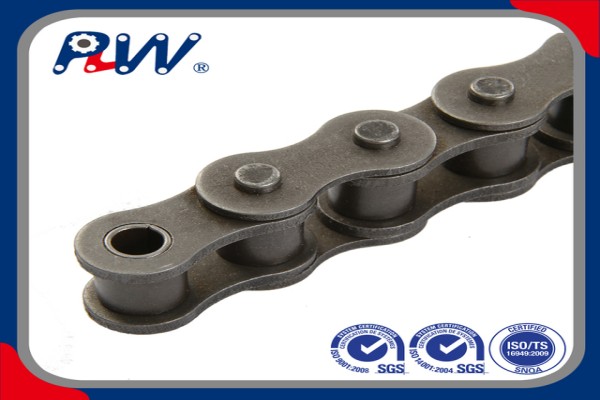
The five core roller chain components
The five core roller chain components are the parts most often named in specifications, diagrams, and maintenance documents. Plates provide the side structure, pins create the pivoting connection, bushings support articulation, and rollers engage the sprocket during operation. Together, these parts allow the chain to transmit power efficiently while handling repeated contact, shock, and tension. This component-based construction is what gives a roller chain its combination of tensile strength and controlled movement.
Component | Primary role in the chain |
Inner plates | Form one side of the inner link and support the bushings |
Outer plates | Form one side of the outer link and hold the pins in place |
Pins | Act as pivot points and connect the chain’s alternating links |
Bushings | Provide a bearing surface between the pins and rollers |
Rollers | Contact the sprocket teeth and reduce friction during engagement |
What the plates do in the chain structure
Inner plates and outer plates form the chain’s side profile and give the assembly its basic structural shape. The inner plates hold the bushings, while the outer plates hold the pins, so each plate type supports a different part of the chain’s link geometry. As the chain transmits load, the plates help maintain spacing, alignment, and overall integrity. They also carry a substantial portion of the tensile force generated during operation, which is why plate thickness and strength matter so much in demanding applications. Heavier-duty chains often use thicker side plates for higher strength, but even in standard designs, the plates are far more than simple outer covers; they are core load-bearing elements within the chain body.
What the pins, bushings, and rollers do
Pins, bushings, and rollers form the moving contact system of a roller chain. The pin serves as the pivot point of articulation, allowing one link to move relative to the next as the chain wraps around a sprocket. The bushing sits between the pin and the roller, providing the surface that supports movement and absorbs wear at a critical contact zone. The roller, mounted over the bushing, is the part that meets the sprocket tooth directly. Instead of forcing the chain to slide harshly into engagement, the roller helps convert that interaction into smoother rolling contact, which reduces friction and limits wear on both the chain and the sprocket. When these three parts are manufactured accurately and kept in good condition, the chain runs more smoothly, elongates more slowly, and performs more reliably under repeated cycles.
How are roller chain parts arranged into links?
A roller chain is not assembled as one uninterrupted strip of metal. Its structure is based on two alternating link forms that repeat throughout the chain body. This link-by-link construction is what allows the chain to remain strong in tension while still bending smoothly around sprockets. In practical terms, the arrangement of parts matters just as much as the names of the parts themselves, because each component has a fixed position inside the link pattern and a specific job during motion.
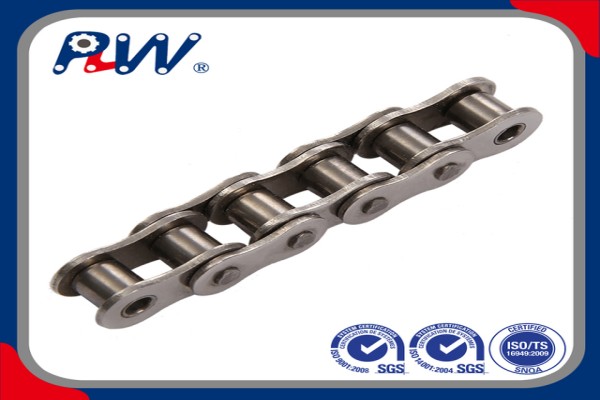
Inner link and outer link
The inner link is the assembly built from inner plates, bushings, and rollers. Two inner plates hold the bushings in position, and the rollers fit over those bushings so they can rotate freely during sprocket engagement. This link is sometimes described as the roller link because it contains the roller assemblies that directly meet the sprocket teeth. The inner link creates the bearing surface and rolling contact area that distinguish a roller chain from simpler chain designs.
The outer link is the assembly made from outer plates and pins. The pins are fixed into the outer plates and pass through the bushings of the neighboring inner link, joining the chain together while also forming its pivoting axis. In a standard roller chain, inner links and outer links alternate in sequence across the full length of the chain. That repeating arrangement creates a flexible articulation system: one link provides the rolling contact elements, while the next provides the connecting and pivoting elements. Without this alternating structure, the chain could not wrap around sprockets and still transmit load effectively.
Link type | Main components | Primary function |
Inner link | Inner plates, bushings, rollers | Provides roller contact and supports bearing surfaces |
Outer link | Outer plates, pins | Connects adjacent links and forms pivot points |
How these parts work together in motion
As the chain approaches a sprocket, each link begins to change angle relative to the next. This bending action happens at the interface between the pins and bushings, where articulation takes place. At the same time, the rollers on the inner links make contact with the sprocket teeth. Instead of forcing the chain body to drag directly across the tooth profile, the rollers help create smoother engagement and reduce friction at the point of contact.
This means the part names are not just labels from a diagram; they describe mechanical roles inside a moving system. Outer links hold the chain together, inner links carry the roller assemblies, pins make pivoting possible, bushings support repeated movement, and rollers manage the chain-to-sprocket contact that defines roller chain operation.
What other roller chain parts or connection pieces are commonly named?
Beyond the five core components of a roller chain, several additional parts and naming terms appear frequently in catalogs, maintenance references, and replacement discussions. These terms do not replace the main component names, but they are closely tied to how a chain is assembled, installed, and specified. In most cases, they refer either to the pieces used to complete the chain loop or to construction labels that modify the basic chain description.
Connecting links
A connecting link is the part used to join the two ends of a roller chain so the chain can be installed as a complete loop. Standard chain assemblies are built from alternating inner and outer links, but installation requires one removable joining piece to close the chain. This is why the connecting link is one of the most commonly named parts outside the core five components. Its naming is practical rather than abstract: it identifies the exact piece used when a chain is assembled, opened, or replaced in service.
Two forms are commonly mentioned. A spring clip type connecting link is widely associated with smaller roller chain sizes, while a cotter pin type connecting link is more often used on medium or larger sizes where additional retention strength is preferred. The distinction usually appears in product descriptions because the fastening style affects installation and service handling as much as chain terminology.
Offset links
An offset link is used when the required chain length calls for an odd number of pitches. Since standard roller chain construction alternates inner and outer links in a repeating pattern, some lengths cannot be achieved with only standard link pairs and a connecting link. The offset link fills that gap by adjusting the chain length without changing the overall chain series. In naming terms, it is often identified as either a single-pitch offset link or a two-pitch offset link, depending on the configuration used.
Named construction variations often mentioned with roller chain
Several terms often appear alongside part names because they describe a chain’s construction rather than a separate product family.
Term | What it indicates |
Heavy-duty chain | Thicker side plates for increased strength |
Straight sidebar chain | Side plates with a straight profile instead of the usual waist shape |
Strand count | Single, duplex, or triplex chain construction |
These labels are especially common in part numbers and technical listings, where a chain may be identified not only by size and standard, but also by whether it is heavy-duty, straight sidebar, or built in multiple strands.
How is a roller chain identified in practice?
In practice, a roller chain is rarely identified by appearance alone. The most reliable method combines the part number, the construction marks in that number, and the visible condition of the main components. This matters because two chains can look similar at a glance while differing in pitch, standard, plate style, or strand count. In technical documents and supplier listings, the naming system is designed to communicate those differences quickly, which is why understanding the code attached to a chain is often the first step in identifying it correctly.
What part numbers usually indicate
Roller chain part numbers typically indicate pitch first, and they also signal which standard system the chain follows. In ANSI-style numbering, the number is commonly tied to pitch in increments of one-eighth of an inch. A designation such as 40 corresponds to a pitch of 4/8 inch, while a larger number such as 120 indicates 12/8 inch. In British Standard notation, the numbering works differently and is typically associated with one-sixteenth-inch pitch increments, with a letter designation such as B appearing as part of the name. This is why a chain marked 08B and one marked 40 may both point to the same half-inch pitch while still belonging to different naming systems.
At a practical level, this means the part number is not just a label for ordering. It is a compact way of identifying the chain’s size standard and basic dimensional family. When a replacement chain is needed, pitch and standard must match the sprocket system already in use, so those numbering conventions become part of everyday identification rather than just catalog language. A chain can therefore be described accurately only when both the number and the standard behind it are understood together.
How construction details change the way a chain is described
Part numbers often include extra markings that change the meaning of the description beyond size alone. These markings identify specific construction details that affect how the chain is built and how it should be referred to in listings or technical conversations.
Marking or format | What it usually indicates |
H | Heavy-duty construction with thicker side plates |
F | Straight sidebar design |
-2 / -3 | Duplex or triplex strand count |
B in BS notation | British Standard series identification |
A chain marked 100H, for example, is not simply size 100; it is a heavy-duty version of that chain size. A chain marked 60F identifies a straight sidebar variation rather than a standard side plate form. Strand count is also built into naming, with suffixes such as -2 and -3 indicating duplex and triplex versions. These additions are important because real-world chain identification usually depends on the full designation, not the base number alone.
Which parts are most often checked during inspection
During inspection, the components most often checked are the pins, bushings, rollers, plates, and connecting links, because these are the areas where wear, deformation, or visible damage usually appears first. Pins and bushings are closely associated with elongation over time, since repeated articulation gradually changes the working fit between them. Rollers are checked for free movement, cracking, or surface damage where they contact sprocket teeth. Plates are examined for bending, cracking, or unusual wear at the side profile, especially in applications with high load or misalignment. Connecting links are also important inspection points because they are separate joining pieces and can show retention or assembly problems more clearly than riveted sections.
In maintenance contexts, these names are used not just for description but for fault identification. A chain may be identified as the correct size on paper, yet inspection may reveal worn bushings, seized rollers, damaged plates, or a compromised connecting link. That is why practical chain identification always combines naming, number format, and visible component condition rather than relying on a single reference point.
Conclusion
The main parts of a roller chain are inner plates, outer plates, pins, bushings, and rollers. These parts form inner and outer links, with connecting and offset links added when needed. Clear terminology supports accurate inspection, replacement, and specification. HANGZHOU PERPETUAL MACHINERY & EQUIPMENT CO., LTD. delivers reliable roller chain products with durable performance and practical service value.
FAQ
Q: What are the main parts of a roller chain?
A: A roller chain has inner plates, outer plates, pins, bushings, and rollers.
Q: How is a roller chain arranged into links?
A: A roller chain uses alternating inner links and outer links to create flexible articulation.
Q: What does a connecting link do in a roller chain?
A: A roller chain connecting link joins the chain ends for installation or replacement.
Q: How do you identify roller chain size?
A: Roller chain size is identified by part number, pitch, standard, and strand count.

 Español
  English
  العربية
  Français
  Русский
  Português
  Deutsch
  italiano
  日本語
日本語  한국어
한국어  Nederlands
  Tiếng Việt
  ไทย
ไทย  Polski
  Türkçe
  አማርኛ
አማርኛ  ພາສາລາວ
  ភាសាខ្មែរ
  Bahasa Melayu
  ဗမာစာ
ဗမာစာ  தமிழ்
தமிழ்  Filipino
  Bahasa Indonesia
  magyar
  Română
  Čeština
  Монгол
  қазақ
қазақ  Српски
  हिन्दी
  فارسی
فارسی  Kiswahili
  Slovenčina
  Slovenščina
  Norsk
Norsk  Svenska
  українська
  Ελληνικά
  Suomi
Suomi  Հայերեն
  עברית
עברית  Latine
  Dansk
Dansk  اردو
اردو  Shqip
Shqip  বাংলা
বাংলা  Hrvatski
  Afrikaans
  Gaeilge
  Eesti keel
  Māori
Māori  සිංහල
සිංහල  नेपाली
  Oʻzbekcha
  latviešu
  অসমীয়া
  Aymara
  Azərbaycan dili
  Bamanankan
  Euskara
  Беларуская мова
  भोजपुरी


