Selecting an industrial drive component is never just a simple commodity purchase. We must view it as a critical risk-management decision. Under-specifying your drive components leads to catastrophic downtime and broken equipment. Conversely, over-specifying unnecessarily inflates your capital expenditure for zero added benefit. Modern engineering has shifted away from relying solely on theoretical load limits. We now focus heavily on real-world operational factors. We evaluate sudden shock loads, harsh environmental contamination, and demanding, continuous duty cycles. Choosing the right component prevents premature wear. It saves immense maintenance labor over the equipment's lifespan. You need a highly structured evaluation framework. This framework bridges the gap between theoretical engineering specifications and daily procurement realities. It ensures your chosen transmission chain meets exact application demands perfectly. You will learn how to balance load requirements effectively. We will explore dimensional standards and environmental mitigations. Finally, we provide a step-by-step selection framework to guide your next project successfully.
Key Takeaways
- Application Dictates Geometry: Selecting between standard, double pitch, or specialized chains depends entirely on the balance of speed, load, and spatial constraints.
- Standards Are Non-Negotiable: Matching ANSI or ISO/BS standards to existing sprockets is critical to prevent rapid, uneven wear.
- Environment Outweighs Baseline Specs: Tensile strength metrics matter less than material finish and lubrication type when operating in corrosive or high-debris environments.
Defining Baseline Requirements for a Transmission Chain
People often confuse ultimate tensile strength with actual working load capacity. Tensile strength measures the absolute breaking point under a static, pulling load. Working load dictates what the setup handles continuously during active motion. Relying purely on tensile strength is a common, dangerous engineering mistake. You must calculate the maximum working load carefully. Apply appropriate safety factors to ensure long-term reliability. Industry standards typically recommend a 6:1 safety ratio for exceptionally smooth loads. Applications experiencing heavy shocks require up to a 9:1 safety ratio. A rock crusher demands a completely different safety margin than a simple packaging conveyor.
Next, we address design horsepower and maximum RPM limits. You cannot use standard engine horsepower alone to size your drive. You must multiply base horsepower by an established service factor. This service factor accounts for the input power type. It also measures the driven equipment's shock level. Electric motors provide smooth, continuous torque. Internal combustion engines deliver pulsating, erratic torque waves. You must account for these torque spikes mathematically to prevent pin bending.
Establish the physical constraints of your entire setup early. Drive ratios and center distances matter greatly for drive longevity. A proven rule of thumb helps optimize your overall performance. Keep center distances between 30 and 50 times the component's pitch. Shorter center distances cause rapid, severe wear on sprocket teeth. Longer center distances create excessive slack. Slack causes the drive to whip uncontrollably at high speeds.
Common Service Factor Multipliers
| Load Characteristic | Smooth Input (Electric Motor) | Pulsating Input (Combustion Engine) |
| Uniform Load (Agitators, Fans) | 1.0 | 1.2 |
| Moderate Shock (Cranes, Hoists) | 1.3 | 1.4 |
| Heavy Shock (Crushers, Presses) | 1.5 | 1.7 |
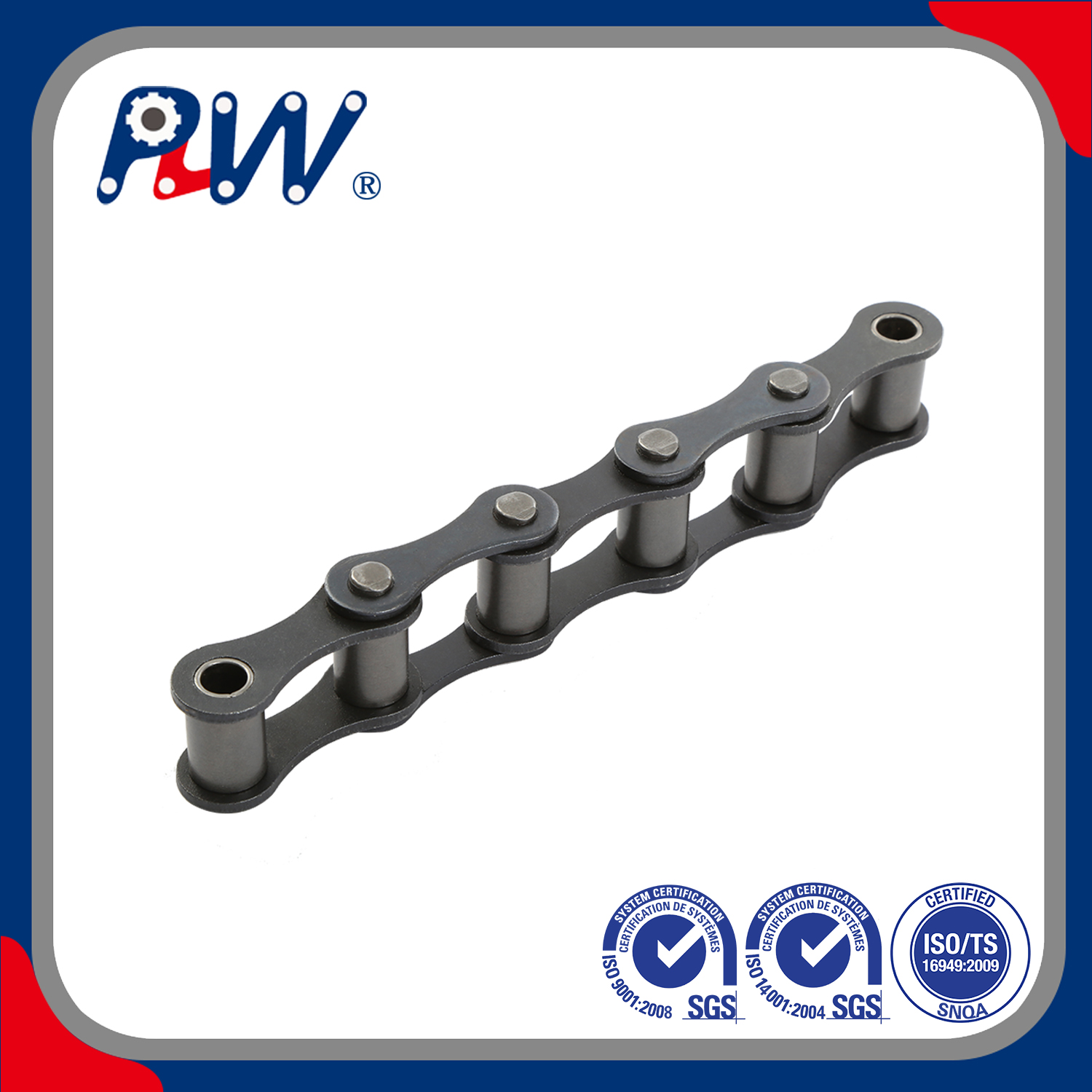
Evaluating Core Industrial Roller Chain Categories
You must evaluate different geometric configurations for your specific application. The physical shape of the links dictates their functional limits.
- Standard Single-Pitch Roller Chains: This is the most common and robust configuration available globally. They are best for high-speed, high-load continuous power transmission setups. A standard roller chain delivers maximum power density in compact spaces. It grips sprocket teeth firmly and securely. The trade-offs involve strict maintenance protocols. This setup requires meticulous alignment across all rotating shafts. You must also ensure regular, precise fluid lubrication to prevent heat buildup.
- Double Pitch Roller Chain: Think of this as a standard design stretched out significantly. They are best for conveyor systems and bulk material handling. Engineers use a double pitch roller chain for light-duty transmission over long center distances. The trade-offs are quite clear and unavoidable. It operates at much slower maximum speeds safely. It utilizes half the components per foot. This reduces overall weight and initial expenditure. However, it lowers the overall power capacity significantly.
- Side Bow Chain (Curve-Negotiating Chain): Some facilities have complex, nonlinear routing needs. This category is best for applications requiring lateral flexibility. Curved conveyor tracks and winding bottling lines rely on them heavily. A specialized side bow chain handles these tight curves perfectly. Trade-offs exist here too. Extra clearance between pins and bushings allows the turning motion. This inherent looseness reduces the maximum allowable working load. It cannot match standard straight-line configurations under heavy tension.
Navigating Dimensional Standards: ANSI Roller Chain vs. ISO/British Standard
Dimensional standards control component interoperability strictly. A significant risk exists when mixing global standards arbitrarily. Drive components might look completely identical to the naked eye. However, mixing standards across links and sprockets causes immediate binding. You will experience rapid wear and inevitable system failure. The rollers will not seat perfectly into the sprocket valleys.
The American National Standards Institute governs the standard B29.1 specification. It uses a specific, highly logical numerical nomenclature. For example, you see sizes labeled "40", "50", or "60". The first digit represents the pitch in 1/8-inch increments. An ANSI roller chain is highly common in North American machinery. A number 40 indicates a 4/8-inch, or half-inch, pitch. A number 60 indicates a 3/4-inch pitch.
Conversely, we have the ISO and British Standard (BS) specifications. They rely entirely on metric-based dimensional frameworks. You will see designations like 08B, 10B, or 12B. These components feature completely different internal pin diameters. Their roller widths vary significantly compared to ANSI counterparts. This distinction is crucial for emergency replacement scenarios. Imported machinery from Europe or Asia usually requires ISO/BS components.
Best Practices for Standard Verification
Never eyeball physical sizes during replacement procedures. Always measure the pin diameter and roller width using digital calipers. Count the number of teeth on your sprockets. Verify the origin country of the driven equipment. Mismatched components often run smoothly for a few hours. They then disintegrate rapidly under load, destroying nearby guards and sensors.
Implementation Risks: Environmental Factors and Wear Mitigation
Baseline mathematical specifications mean nothing in a hostile operating environment. Environmental factors dictate actual operational lifespan entirely. Corrosion and chemical exposure destroy standard carbon steel rapidly. We must evaluate protective coatings carefully. Nickel-plated and zinc-plated options offer moderate surface protection. They resist light washdowns and humid air. Stainless steel is the ultimate choice for extreme conditions. Let us review a necessary reality check. Stainless steel offers superior corrosion resistance against harsh acids. However, it has a significantly lower yield strength. You must de-rate these applications accordingly. You cannot swap standard steel for stainless without recalculating loads.
Abrasive environments present another massive operational challenge. Dust, dirt, and sand act like grinding paste inside joints. We discuss the necessity of sealed mechanisms constantly. Specialized O-ring and X-ring setups keep abrasives out effectively. They protect the critical pin and bushing contact area. This extends functional life dramatically in dirty environments. It does add slight initial expense and minor operating friction due to rubber compression.
Finally, we face harsh lubrication realities. Frame lubrication as a strict design parameter from day one. It is never an optional, afterthought maintenance task. Manual and drip lubrication work fine for clean environments. However, hard-to-reach areas demand different engineering strategies. Specify self-lubricating mechanisms immediately. Units utilizing specialized sintered bushings hold internal oil securely. They excel in contamination-sensitive zones like busy food processing lines. They eliminate messy drips while maintaining internal joint lubrication.
Environmental Protection Comparison Chart
| Material or Coating | Corrosion Resistance | Strength Capacity | Ideal Operational Environment |
| Standard Carbon Steel | Very Low | Maximum Baseline | Clean, fully lubricated, indoor drives |
| Zinc / Nickel Plated | Moderate | High (Matches Carbon) | Intermittent moisture, outdoor exposure |
| 300-Series Stainless Steel | Excellent | Significantly Reduced | Food processing, chemical washdowns |
A Step-by-Step Roller Chain Selection Framework
We synthesize these engineering principles into a practical selection framework. Following this structured process guarantees a reliable industrial roller chain deployment. Guesswork has no place in mechanical power transmission.
- Step 1: Determine the Service Factor accurately. Assess the precise nature of your expected load. Identify if it represents uniform operation or heavy shock. Evaluate your input drive motor. Consult standard service factor charts to find your multiplier.
- Step 2: Calculate Design Horsepower precisely. Multiply your base engine power requirement by your chosen service factor. This gives you the true operational demand. Use this inflated number for all subsequent calculations.
- Step 3: Select Chain Pitch intelligently. Use standard manufacturer horsepower rating tables. Intersect the RPM of your smallest drive sprocket with your calculated design horsepower. Choose the smallest pitch handling the power requirement. Smaller pitches provide the smoothest operation and highest RPM limits.
- Step 4: Verify System Parameters thoroughly. Confirm your selected components fit within existing spatial limits. Check maximum allowable sprocket diameters. Verify the optimal center distance fits your frame. Ensure everything matches existing shaft sizes perfectly before ordering.
Conclusion
Successful power transmission requires meticulous attention to detail. It relies on aligning load characteristics accurately. You must follow strict dimensional standards rigidly. You must also respect harsh environmental realities during the design phase. Procurement and engineering teams should audit existing failure points together. If current drive mechanisms stretch too quickly, investigate the root cause. Look for hidden, undocumented shock loads. Check for an absolute lack of internal lubrication. Do not simply buy a heavier, thicker component blindly. This merely moves the failure point to your expensive shafts. Consult a technical specialist today. Download a dimensional selection guide. Request a custom application review to finalize your specifications confidently.
FAQ
Q: Can I replace an ANSI roller chain with a British Standard (BS) chain?
A: No. Despite potential similarities in pitch, the roller diameters and pin widths differ. Using mismatched chains and sprockets will cause severe damage to the drive system. They will bind immediately and wear unevenly.
Q: How do I know when an industrial roller chain needs replacing?
A: Measure for elongation. People often call this "stretch," which is actually wear at the pin and bushing joints. An elongation of 1.5% to 3% over a specific number of pitches indicates the end of its functional life.
Q: What is the difference between standard and heavy-duty (H-Series) roller chains?
A: Heavy-duty chains feature thicker link plates. They share the same pitch and roller width as standard chains. They offer higher fatigue resistance. They withstand shock loads better. They do not increase the maximum RPM capacity.
Q: Are double pitch roller chains suitable for power transmission?
A: Yes, but strictly for light-load, low-speed applications. Their primary use is in conveying and material handling. They excel where long center distances are required. The significant weight reduction is highly beneficial here.

 Español
  English
  العربية
  Français
  Русский
  Português
  Deutsch
  italiano
  日本語
日本語  한국어
한국어  Nederlands
  Tiếng Việt
  ไทย
ไทย  Polski
  Türkçe
  አማርኛ
አማርኛ  ພາສາລາວ
  ភាសាខ្មែរ
  Bahasa Melayu
  ဗမာစာ
ဗမာစာ  தமிழ்
தமிழ்  Filipino
  Bahasa Indonesia
  magyar
  Română
  Čeština
  Монгол
  қазақ
қазақ  Српски
  हिन्दी
  فارسی
فارسی  Kiswahili
  Slovenčina
  Slovenščina
  Norsk
Norsk  Svenska
  українська
  Ελληνικά
  Suomi
Suomi  Հայերեն
  עברית
עברית  Latine
  Dansk
Dansk  اردو
اردو  Shqip
Shqip  বাংলা
বাংলা  Hrvatski
  Afrikaans
  Gaeilge
  Eesti keel
  Māori
Māori  සිංහල
සිංහල  नेपाली
  Oʻzbekcha
  latviešu
  অসমীয়া
  Aymara
  Azərbaycan dili
  Bamanankan
  Euskara
  Беларуская мова
  भोजपुरी


