Roller chain components include the individual parts that make up a roller chain, such as plates, pins, bushings, and rollers. When you understand each part, you can quickly spot wear and choose the right replacements, which helps avoid costly mistakes. In industrial settings, knowing your roller chain components can reduce failures by 60% and extend chain life by up to 50%. This attention to detail saves money, lowers downtime, and ensures your equipment stays compatible and efficient.
Evidence Type
Reduction in Failures
Extension of Chain Life
Failure Analysis
60%
40-50%
Key Takeaways
Understand each roller chain part to spot wear and choose replacements.
Proper maintenance extends chain life and reduces failures by up to 60%.
Choose the right materials for your environment to avoid early failure.
Match chain size and pitch to your machine for best performance.
Understanding Roller Chain Components
Definition and Function
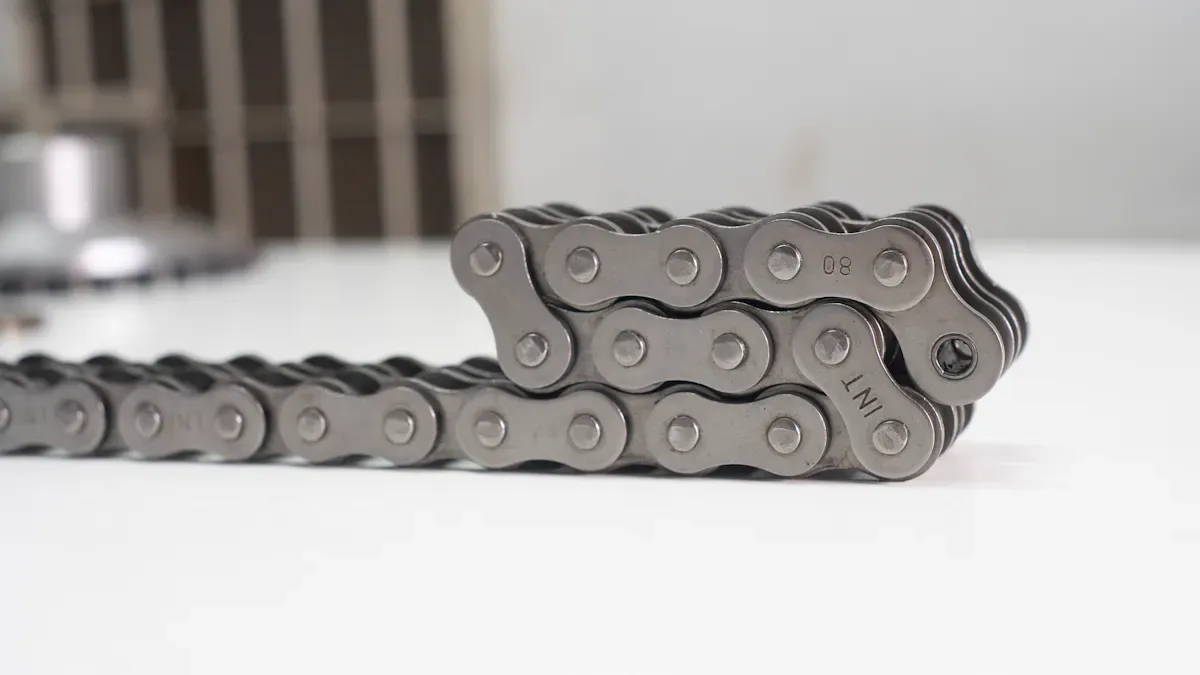
You can think of roller chain components as the building blocks that make up a roller chain. Each part has a specific job that helps the chain move smoothly and last longer. When you look at a roller chain, you will see several key parts working together:
Inner plates keep the rollers and bushings spaced correctly. They handle tension and help prevent the chain from stretching.
Outer plates hold the chain together. They carry heavy loads and often have extra thickness for tough jobs.
Pins act as pivot points. They take on shearing forces and play a big role in how long your chain lasts.
Bushings serve as bearing surfaces for the pins. They protect the pins from wearing out and absorb shocks when the chain engages with the sprocket.
Rollers spin freely to reduce friction. They turn sliding friction into rolling friction, which helps both the chain and sprocket last longer.
When you understand the function of each part, you can see how roller chain components work together to transfer power efficiently in machines.
Why Components Matter
If you want your roller chain to run smoothly and last longer, you need to pay attention to each component. Proper alignment of sprockets and chains spreads the load evenly. This reduces wear and tear, which means your chain and sprockets will last longer. If the chain is not aligned, friction increases. This wastes energy and puts extra stress on the chain, which can lead to breakdowns.
You should also know that regular maintenance, such as checking alignment and adding lubrication, boosts the lifespan and efficiency of your roller chain. Sprockets, tensioners, and attachments all play important roles. Sprockets help the chain transmit power. Tensioners keep the chain tight and prevent vibration. Attachments let the chain do extra jobs, like moving products in a factory.
Tip: Most roller chain failures happen because of poor lubrication, misalignment, or overloading. If you keep up with maintenance, you can avoid these problems and keep your equipment running smoothly.
Essential Roller Chain Parts
Understanding the main roller chain parts helps you maintain your equipment and choose the right replacements. Each part plays a unique role in the performance and durability of your roller chain assembly. Let’s break down the core chain parts you will find in most roller links.
Inner Plates
Inner plates form the backbone of roller links. You will find these plates inside the chain, connecting the bushings and rollers. They keep the chain parts aligned and help distribute tension evenly. When you look at different roller chain sizes, you will notice that the dimensions of inner plates change based on the pitch and width. The table below shows standard dimensions for inner plates according to ANSI and ISO standards:
Pitch (P)
Roller Diameter (W)
Roller Width (R)
Plate Height (H)
Plate Thickness (T)
Pin Diameter (D)
Overall Width (F)
Overall Width (G)
0.500
0.312
0.312
0.475
0.060
0.157
1.165
1.269
0.625
0.375
0.400
0.594
0.080
0.200
1.483
1.550
0.750
0.500
0.469
0.712
0.094
0.235
1.848
1.955
1.000
0.625
0.625
0.950
0.125
0.313
2.392
2.526
1.250
0.750
0.750
1.187
0.156
0.376
2.909
3.063
1.500
1.000
0.875
1.425
0.187
0.437
3.682
3.832
1.750
1.000
1.000
1.662
0.219
0.500
3.959
4.152
2.000
1.250
1.125
1.900
0.250
0.563
4.746
4.920
2.250
1.406
1.406
2.137
0.281
0.687
5.331
5.547
2.500
1.500
1.562
2.375
0.312
0.781
5.814
6.050
3.000
1.875
1.875
2.850
0.375
0.937
7.130
7.366
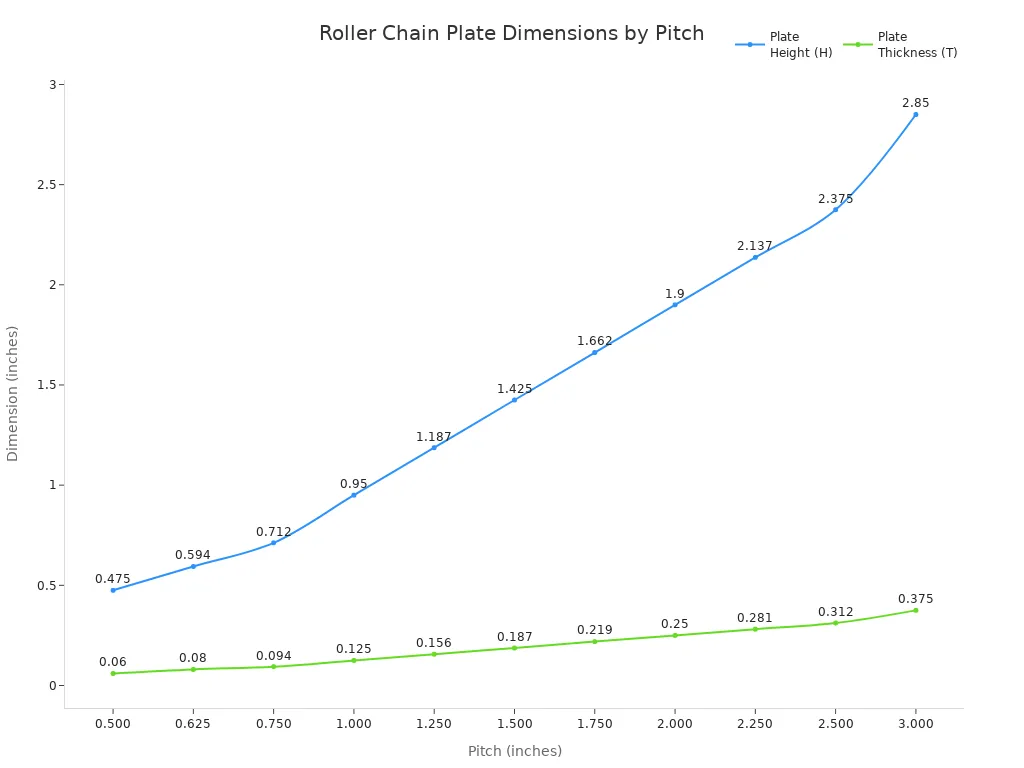
You can also see how plate height and thickness increase with pitch in this chart:
Inner plates must fit tightly with the bushings and rollers. If you notice any bending or cracks, you should replace these chain parts right away to avoid failure.
Outer Plates
Outer plates hold the roller chain together. You will find them on the outside of the roller links, connecting the pins and locking the assembly. These chain parts take on heavy loads and protect the inner parts from impact. The material you choose for outer plates affects how long your roller chain lasts. Here is a quick comparison of common materials and their durability:
Material
Application Context
Durability Influence
Carbon Steel
General industrial applications
Often heat-treated for a hard, wear-resistant surface while maintaining toughness.
Stainless Steel
Food processing, medical, marine environments
Resists corrosion but generally has lower tensile strength and wear life.
Nickel-Plated
Balanced use for corrosion resistance and strength
Offers better corrosion resistance than carbon steel while retaining higher strength.
Plastic/Acetal
Light-duty, noise reduction, chemical resistance
Used where cleanliness and noise reduction are important.
You should also watch for common failure modes in outer plates. Plate fatigue can cause cracks around pin holes after repeated loading. Overload often leads to wear on one side of the chain plates, usually from misalignment. The table below summarizes these issues:
Failure Mode
Description
Plate Fatigue
Initiated by repeated loading cycles exceeding the material's fatigue threshold, leading to cracks around pin holes.
Overload
Results in wear on one side of the chain plates, often due to misalignment, causing uneven stress distribution.
If you see these signs, you should replace the affected roller chain parts to prevent a breakdown.
Pins
Pins act as the pivot points in roller links. You will find them running through the inner and outer plates, holding the chain parts together. The roller chain pin allows the chain to flex and move around sprockets. Over time, pin wear can cause problems. Here is how pin wear affects your roller chain:
Pin wear removes material from both the pins and bushings.
The extra space between the pin and bushing causes the chain to elongate.
As the chain stretches, it rides higher on the sprocket teeth, which can reduce performance and even cause the chain to skip.
You should check for pin wear during regular maintenance. If you notice elongation, you may need to replace the worn chain parts to keep your roller chain assembly running smoothly.
Bushings
Bushings play a key role in reducing friction inside roller links. The roller chain bushing sits between the pin and the roller, providing a smooth surface for the pin to rotate against. This design increases the contact area, spreads the load, and helps prevent rapid wear. Bushings also help your roller chain resist elongation and fatigue.
Earlier chain parts did not include bushings, which led to fast wear and poor performance. The addition of bushings improved wear distribution and reduced friction. When you select bushings, you should consider the environment. For example:
Nickel-plated carbon steel and 316 stainless steel bushings help prevent corrosion.
Corrosion resistance avoids stress corrosion cracking, which can shorten chain life.
In harsh environments, the right bushing material helps your roller chain endure stress and last longer.
If you see signs of wear or corrosion on bushings, you should replace these chain parts to keep your roller chain components in top shape.
Rollers
Rollers are the moving parts that contact the sprocket teeth. The roller chain roller spins freely around the bushing, turning sliding friction into rolling friction. This action reduces wear on both the chain and the sprocket. You will find that surface treatments can make a big difference in high-speed or noisy environments. The table below shows how different treatments affect noise and wear:
Surface Treatment
Benefits
Impact on Noise and Wear
Hard Chrome Plating
Enhances hardness, corrosion resistance, and wear resistance.
Reduces friction, minimizing wear and noise.
Coatings
Provides protection against wear, corrosion, and chemical attacks.
Increases hardness and wear resistance.
Polyurethane Rollers
Offers good wear resistance and excellent shock absorption.
Reduces noise significantly due to shock absorption.
If you want a quieter or longer-lasting roller chain, you should look for rollers with the right surface treatment. Always check for flat spots or cracks on rollers, as these can lead to more serious problems in your roller chain roller link.
Note: Each of these chain parts must work together for your roller chain components to perform well. If you keep an eye on wear and choose the right materials, you will extend the life of your roller chain and avoid costly repairs.
Accessories and Extra Parts
Master Links
You use master links to join the ends of a roller chain or to connect new sections. These connecting links make installation and removal much easier. Most roller chain connecting link types come with a clip or cotter pin to secure the link in place. You should always match the master link to your chain’s size and pitch. If you use the wrong type, you risk chain failure or poor performance.
Offset Links
Offset links, also called roller chain offset link or half links, help you adjust the length of your roller chain by a single pitch. You often need these when your chain does not fit perfectly with standard links. Offset links increase flexibility, letting your chain move around obstacles or fit non-linear layouts.
Offset links keep the rollers engaged with sprocket teeth, so you get high power transmission efficiency.
You can expect transmission efficiency of 96-98% with offset roller chains under good conditions.
These links provide steady torque and reduce power loss, which helps your roller chain last longer.
Attachment Links
Attachment links allow you to customize your roller chain for special tasks, such as moving products on a conveyor. You can find many types of connecting links with attachments for different jobs. The table below shows a common configuration:
Product Name
Configuration
Application Type
Morse 333638 No. 100 D3 connecting link
D3
ANSI roller chain conveyor systems
You should select the right attachment link based on your application’s needs.
Sprockets
Sprockets guide and drive your roller chain. The number of teeth on a sprocket affects speed and torque.
Sprockets with fewer than 17 teeth increase wear because of more chordal action.
For high-speed drives, use sprockets with at least 19 teeth to keep efficiency high.
Slow-speed drives need at least 11 teeth, medium-speed drives need 17, and high-speed drives need 25 or more.
Choosing the right sprocket helps your roller chain run smoothly and last longer.
Tensioners
Tensioners keep your roller chain tight and reduce slack. You can use automatic tensioners, like spring-loaded or hydraulic types, to maintain steady tension.
These tensioners work well for long spans, variable loads, or hard-to-reach places.
Automatic systems lower maintenance and extend the life of your roller chain by keeping tension even as the chain stretches.
Critical operations benefit most from automatic tensioners.
Tip: Regularly check your tensioners and replace them if you notice loss of tension or visible wear.
Component Interaction
How Parts Work Together
Each part of a roller chain plays a unique role, but you get the best performance when all parts work together. The pins, bushings, and rollers interact every time the chain moves. Friction forms between the bushings and pins during operation. Over time, this friction wears down both parts. As the bushings and pins wear, the distance between the rollers increases. This leads to chain elongation, which can affect how your roller chain fits on the sprocket.
You can control wear patterns by keeping the right tension on your roller chain. Proper tension lets the rollers spin freely, which reduces sliding friction and wear. If you set the tension too high, you put extra stress on the pins and bushings. If the tension is too low, the chain may slip or vibrate, which also causes wear. The table below shows how tension affects wear:
Aspect
Effect on Wear Patterns
Proper Tension
Minimizes sliding friction, allowing rollers to rotate freely, reducing wear.
Improper Tension
Increases friction and heat, leading to accelerated wear on pins and bushings.
Over-Tensioning
Causes excessive stress on pins and bushings, contributing to distinct wear patterns.
Under-Tensioning
Results in slippage and vibration, which also affects wear patterns.
Tip: Always check the tension of your roller chain to prevent early wear and keep your equipment running smoothly.
Common Configurations
You will find several common roller chain configurations in industrial machinery. Each type serves a different purpose based on the load and application. The table below highlights the main types:
Configuration Type
Description
Single-Strand (Simplex)
Standard for general power transmission
Double-Strand (Duplex)
Ideal for higher torque and load handling
Triple-Strand (Triplex)
Used in heavy-duty and industrial applications
Quadruple to Duodenary
Designed for conveyors, crushers, and steel plants
You can choose the right roller chain configuration for your needs:
Single strand: light to medium duty
Double strand: increased load capacity
Triple strand: heavy-duty applications
Selecting the correct roller chain setup ensures you get the right balance of strength, durability, and efficiency for your machine.
Materials and Durability
Common Materials
When you choose a roller chain, you need to know which materials work best for your application. Different environments and loads require different materials. Here are some of the most common options:
Stainless steel works well in corrosive environments or food-grade settings. You often see this material in food processing plants or marine equipment.
Nickel-plated chains offer some corrosion resistance at a lower cost than stainless steel. These chains fit well in damp or mildly corrosive areas.
High-temp steel is necessary for ovens or furnaces. This material can handle extreme heat without losing strength.
You will also find that each roller chain component uses specific materials for better performance. The table below shows common choices and their benefits:
Component Type
Material Options
Key Properties
Application Benefits
Solid Pins
Hardened carbon steel, alloy steel
High tensile strength, wear resistance
Heavy-duty use, longer service life
Hollow Pins
Case-hardened steel
Reduced weight, strong
High-speed, weight-sensitive equipment
Standard Bushings
Carbon steel, case-hardened
Good wear properties, cost-effective
General industrial, moderate loads
Specialty Bushings
Stainless steel, bronze
Corrosion resistance, self-lubrication
Food processing, marine environments
Tip: Always match the material of your roller chain to your working environment. This choice helps prevent early failure and keeps your equipment running longer.
Impact on Performance
The material you select for your roller chain has a big effect on how long it lasts and how well it works. Stainless steel and nickel-plated steel both improve corrosion resistance. If you use your roller chain in a place with lots of moisture or chemicals, these materials help prevent rust and damage. Stainless steel contains chromium, which forms a protective layer on the surface. This layer blocks corrosion and keeps your roller chain strong.
High-quality materials and proper heat treatment also boost the fatigue life of your roller chain. When you use chains made from strong, well-treated steel, you get better durability and fewer breakdowns. You will notice less stretching and fewer cracks over time. This means your roller chain will keep working even under heavy loads or tough conditions.
Note: Choosing the right material for your roller chain is one of the best ways to increase its lifespan and reduce maintenance costs.
Selecting Roller Chain Parts
Identifying Wear
You need to check your roller chain for wear to keep your equipment running well. The most reliable way is to measure chain elongation. As the pins and bushings wear down, the distance between the centers of the pins increases. You can use a high-precision tool to measure this change. To check for elongation, measure a section of 10 or more pitches and compare it to the original length. For example, a new 10-pitch section of number 40 roller chain should measure exactly 5.000 inches. If your measurement is 5.075 inches or more, your chain has stretched by 1.5%. In most cases, you should replace the chain at this point. For most industrial uses, a maximum elongation of 3% is acceptable, but for precise work, you may need to replace the chain sooner.
Matching Size and Pitch
When you select roller chain parts, you must match the size and pitch to your machine. The pitch is the distance between the centers of two pins. This measurement decides which sprocket your chain will fit. Here are some important points:
Smaller pitch chains work best for higher speeds and lighter loads.
Larger pitch chains handle heavier loads but move slower.
Mixing different standards, like ISO and ANSI, can cause problems. The roller diameter, tooth shape, and tolerances may not match, which leads to poor engagement and faster wear.
Always check your machine’s manual or the old chain for the correct size and pitch before buying new parts.
Application Considerations
You should think about your application before you decide how to choose the right roller chain parts. Each job has different needs. Consider these factors:
Load requirements
Operating speed
Environmental conditions
Maintenance frequency
Sprocket compatibility
For heavy-duty work, pick a roller chain that can handle high loads and tough conditions. For light-duty jobs, a smaller, faster chain may work better. Always match your roller chain to the job for the best results and longest life.
Maintenance Tips
Signs of Wear
You can spot early signs of wear in your roller chain by using a few simple techniques. Regular checks help you avoid sudden breakdowns and keep your equipment running smoothly. The table below shows common monitoring methods and what they do:
Monitoring Technique
Description
Visualization of key process variables
Watch for changes in elongation, acceleration, and temperature.
Calculation of actual chain length
Measure the chain to find out if it has stretched.
Trend detection analysis
Track wear patterns over time for early warnings.
Limit value monitoring
Set alarms for critical wear conditions.
Optimized maintenance planning
Plan repairs before problems get worse.
You should also look for causes like poor lubrication, heavy loads, or high speeds. Specialized tools can help you measure chain elongation more accurately than a tape measure. If you ignore wear, your roller chain may slip or cause downtime.
Basic Care
Taking care of your roller chain keeps it working longer. Start by checking the chain after the first 50 hours of use. This helps you catch early issues. In tough conditions, inspect your chain every 200 hours. For normal use, check it every 500 hours. Lubricate your roller chain every 100 to 200 hours, depending on how hard it works. Always follow the manufacturer's advice for the best results.
You need to decide when to repair or replace your roller chain. Use these steps to help you choose:
Measure chain stretch. If it grows by more than 0.8% to 1.5%, replace it.
Look for visible wear on rollers, bushings, or pins. Replace if you see damage.
Check for corrosion. Deep rust means you need a new chain.
Inspect sprockets. If they show heavy wear, replace both the chain and sprockets.
Listen for noise or vibration. Strange sounds often mean it is time for a new chain.
Watch for frequent breakage or slack. These signs show the chain cannot handle the load.
If you follow these tips, your roller chain will last longer and work better.
Buying Guide
Where to Buy
You have many options when you want to buy a roller chain. Online retailers like theBigBearingStore, Motion, Oregon Products, Amazon, and NAPA Auto Parts offer a wide selection. You can compare prices and check reviews before you make a choice. Local dealers also provide roller chain parts. Visiting a store lets you see the product and ask questions. Many people find that online marketplaces give more convenience, but local shops can help with urgent needs or special advice.
Tip: Always check if the seller has a good return policy. This protects you if the roller chain does not fit your equipment.
Quality Checklist
Before you buy a roller chain, you should check a few key details. Use this checklist to make sure you get the right part:
Confirm the size and pitch match your machine’s requirements.
Check the material. Stainless steel, nickel-plated, or carbon steel each work best in different environments.
Inspect product photos for clear markings and specifications.
Read customer reviews for feedback on durability and fit.
Ask about warranty or support options.
Feature
What to Check
Size & Pitch
Matches your old roller chain
Material
Suits your work environment
Markings
Clear and easy to read
Reviews
Positive and recent
Tips for Beginners
If you are new to buying roller chain parts, start by measuring your old chain. Write down the pitch, width, and length. Bring these numbers when you shop. Use online tools or guides from trusted retailers to double-check your selection. Do not mix different standards like ANSI and ISO. This can cause poor fit and faster wear. Ask for help if you feel unsure. Many suppliers offer customer support for beginners.
Note: Taking time to compare options and check details helps you avoid costly mistakes and keeps your roller chain running smoothly.
You now understand why learning about roller chain components matters. When you know each part, you can spot problems early and choose the right roller chain for your needs. Regular care and smart replacement keep your roller chain working longer. Use this guide when you buy or replace roller chain parts.
For best results, check manufacturer specifications or talk to a trusted supplier before making a purchase.
Review your roller chain often.
Replace worn parts quickly.
Ask for expert advice if you feel unsure.
FAQ
What is the most common cause of roller chain failure?
Poor lubrication causes most roller chain failures. You should check and lubricate your chain often. This step reduces friction and prevents early wear.
How do you measure roller chain pitch?
You measure pitch by finding the distance between the centers of two pins. Use a ruler or caliper for accuracy. Write down the measurement before buying new parts.
Can you mix different roller chain brands?
You should not mix brands. Chains from different brands may have small size differences. These differences can cause poor fit and faster wear.
How often should you replace a roller chain?
Check your chain every few months. Replace it if you see stretching, rust, or broken parts. Most chains last one to three years with good care.
What lubricant works best for roller chains?
Use a high-quality chain lubricant. Avoid grease or thick oils. Light oil or spray lubricants reach inside the chain and protect moving parts.

 Español
  English
  العربية
  Français
  Русский
  Português
  Deutsch
  italiano
  日本語
日本語  한국어
한국어  Nederlands
  Tiếng Việt
  ไทย
ไทย  Polski
  Türkçe
  አማርኛ
አማርኛ  ພາສາລາວ
  ភាសាខ្មែរ
  Bahasa Melayu
  ဗမာစာ
ဗမာစာ  தமிழ்
தமிழ்  Filipino
  Bahasa Indonesia
  magyar
  Română
  Čeština
  Монгол
  қазақ
қазақ  Српски
  हिन्दी
  فارسی
فارسی  Kiswahili
  Slovenčina
  Slovenščina
  Norsk
Norsk  Svenska
  українська
  Ελληνικά
  Suomi
Suomi  Հայերեն
  עברית
עברית  Latine
  Dansk
Dansk  اردو
اردو  Shqip
Shqip  বাংলা
বাংলা  Hrvatski
  Afrikaans
  Gaeilge
  Eesti keel
  Māori
Māori  සිංහල
සිංහල  नेपाली
  Oʻzbekcha
  latviešu
  অসমীয়া
  Aymara
  Azərbaycan dili
  Bamanankan
  Euskara
  Беларуская мова
  भोजपुरी