1. Introduction
Have you ever wondered which gear is best for your system? While Helical gears are known for their smooth and quiet performance, are they always the right choice?
In this article, we’ll compare helical gears with spur gears, examining their key differences and benefits. You’ll learn when each gear type is most effective and how to make the best decision for your needs.
2. Comparison: Spur Gears vs. Helical Gears (Core Mechanical Differences)
Tooth Geometry: Straight vs. Angled Engagement
The most fundamental difference between spur gears and helical gears lies in their tooth geometry. Spur gears feature straight teeth that mesh directly, which leads to a more instantaneous and high-impact tooth engagement. As the teeth come into contact with each other, the load is transferred quickly, which creates more vibration and noise. This design is simple and cost-effective but has limitations in terms of load capacity and noise control.
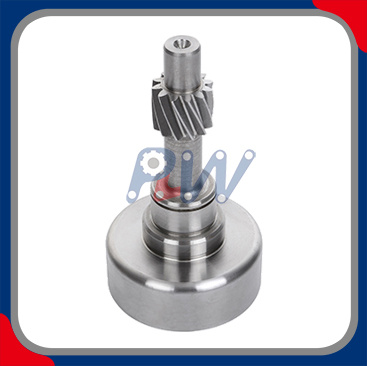
In contrast, helical gears have teeth that are cut at an angle to the axis of rotation. This spiral tooth design allows for progressive meshing, where the teeth gradually come into contact instead of meshing all at once. This gradual engagement reduces impact loads and makes helical gears much smoother and quieter during operation. The progressive meshing of the teeth also leads to better load distribution, which enables helical gears to handle higher loads compared to spur gears, making them ideal for high-torque and high-speed applications.
Power Transmission Behavior
When it comes to power transmission, spur gears transmit force directly with each tooth engaging at the same time. This direct engagement generates a more abrupt force transfer, which can result in greater shock loads, vibrations, and noise. While this is manageable in lower-load and slower-speed applications, it becomes inefficient and problematic as the load and speed increase.
Helical gears, on the other hand, engage progressively. As one tooth starts to mesh, the next one gradually joins the contact. This smooth engagement reduces the shock loading, minimizes vibrations, and leads to quieter operation, which is crucial in industries such as automotive gearboxes, where smooth power transfer is essential for comfort and efficiency.
Axial Thrust vs. Radial Load
One important characteristic of helical gears is the axial load they generate. Due to the angled tooth design, helical gears produce both radial and axial forces. The axial force pushes along the axis of rotation, which requires additional support from thrust bearings to handle this load. This extra consideration adds complexity to the design and increases the need for stronger shaft materials, more precise alignments, and additional bearings.
In contrast, spur gears only create radial forces that push perpendicularly to the axis of rotation. As a result, spur gears do not require thrust bearings, making them simpler and more cost-effective to design and manufacture. However, the lack of axial force limits their load-carrying capacity compared to helical gears.
Contact Ratio and Durability
The contact ratio refers to the number of teeth that are engaged at a given time. Helical gears typically have a higher contact ratio, which means that more teeth are in contact during operation. This leads to better load distribution, as the force is spread over multiple teeth. The higher contact ratio also reduces wear and tear on the individual teeth, improving the overall durability and lifespan of the gear.
Spur gears, with their lower contact ratio, have fewer teeth in contact at a time. While this doesn’t necessarily mean that they are less durable, it does mean that the load is concentrated on fewer teeth, which can lead to faster wear and shorter service life under high-load conditions.
3. Helical Gears vs. Spur Gears: Performance Under Real Working Conditions
Noise and Vibration
The smooth operation of helical gears is one of their most significant advantages over spur gears. The progressive tooth meshing reduces the shock load at each engagement, leading to lower vibrations and noise levels. This feature makes helical gears particularly well-suited for applications where noise reduction is a priority, such as in automotive gearboxes, high-speed machinery, and robotic systems.
In contrast, spur gears produce more noise due to the instantaneous meshing of teeth. The sudden engagement results in a higher impact force, which generates more vibration and acoustic energy. Although spur gears are quieter at lower speeds and loads, they become significantly noisier as the speed increases, making them less desirable for high-speed or noise-sensitive applications.
Torque Capacity and Load Distribution
One of the standout features of helical gears is their ability to handle higher torque and load. The progressive contact between the teeth allows for a larger contact area, which helps in distributing the load more effectively across the gear. This results in higher load capacity compared to spur gears, which rely on a smaller contact area, making them less effective at transferring heavy loads.
Helical gears can typically handle 30%-50% more load than spur gears of the same size. This increased load capacity makes helical gears the preferred choice for applications such as high-performance automotive gearboxes, industrial compressors, and heavy-duty machinery that require efficient torque transmission.
High-Speed Performance
At high speeds, helical gears perform significantly better than spur gears. The smooth tooth meshing reduces the chances of resonance and vibration, which can cause instability and failure at higher RPMs. Spur gears, on the other hand, tend to produce more vibration at high speeds due to the sudden engagement of the teeth, which can lead to system instability and premature wear.
Precision and Backlash
Both helical gears and spur gears can achieve tight backlash control, but helical gears are more sensitive to misalignment due to the axial load they generate. Even slight misalignments can cause uneven wear patterns, which reduce the lifespan of the gear and lead to system inefficiency. Spur gears, on the other hand, can tolerate misalignment better, making them easier to install and maintain in applications where precision alignment is not critical.
4. When to Choose Helical Gears (Best-Use Scenarios)
Quiet Operation at High RPM
If your application requires low noise at high speeds, such as in automotive transmissions or high-precision robotics, helical gears are the clear choice. Their smooth meshing action minimizes vibrations and noise, making them ideal for situations where noise reduction is a top priority.
Compact Systems Needing Higher Load Density
Helical gears are ideal for compact applications that need to transmit high torque in a limited space. Because helical gears have a larger contact area, they can handle higher load densities, making them perfect for systems like robotic joints, compact gearboxes, and automotive drivetrains where space is limited but high performance is required.
Continuous Duty Cycles
Helical gears are well-suited for applications that run continuously, such as conveyors, mixers, and compressors. The smooth meshing action and reduced impact loads make helical gears more durable and capable of handling prolonged operations without failure.
Hidden Design Costs
While helical gears offer superior performance in high-load applications, their design comes with hidden costs. The axial forces generated by helical gears require the use of thrust bearings and more robust housing designs. These additional components can increase both the initial cost and maintenance requirements, making it essential to carefully consider the overall system design.
5. When Spur Gears Are the Better Option
Low-Cost, Low-Complexity Designs
For applications where cost-effectiveness and simplicity are the primary concerns, spur gears are often the better choice. Their simpler design makes them less expensive to produce and easier to maintain. They are ideal for low-load applications, such as light-duty conveyors and basic machinery.
Efficiency-First Gear Trains
If your application places a premium on energy efficiency, spur gears may be the preferred choice. Because spur gears have less sliding friction compared to helical gears, they tend to be more energy-efficient at lower speeds and loads. This makes them suitable for battery-operated machinery and other systems where minimizing energy loss is important.
Easy Maintenance and Replacement
Spur gears are simpler to install and maintain due to their straightforward design. This makes them easier and quicker to replace when needed, which is an advantage in industries that require low-maintenance, high-reliability gear systems. Spur gears are often used in small machine tools, test rigs, and low-speed systems.
Best Applications
Spur gears are commonly used in applications that don’t require high precision or load capacity. These include basic reducers, light-duty applications, and prototype machines.
6. Cost, Manufacturing, and Maintenance Comparison
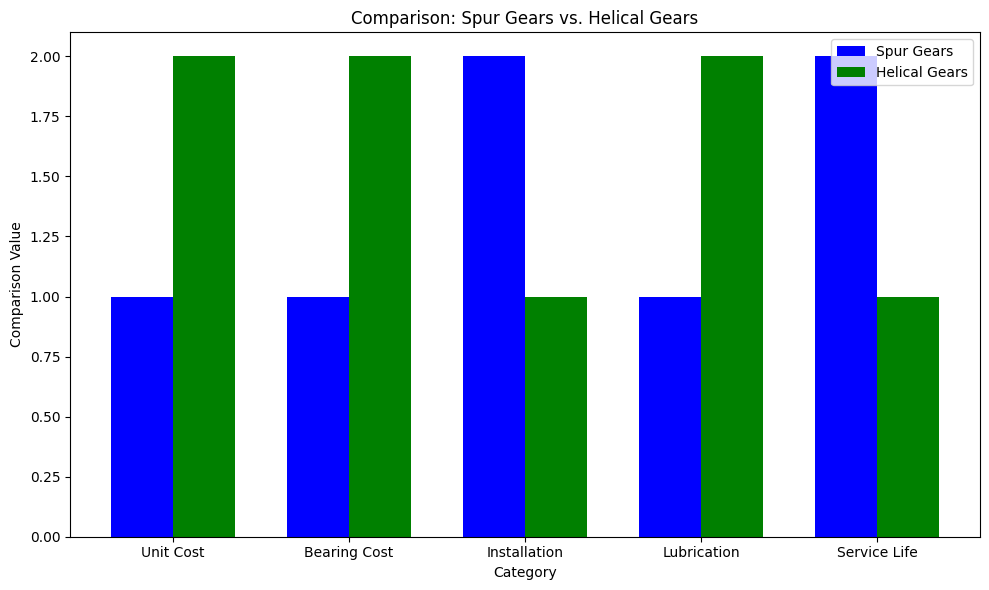
Category | Spur Gears | Helical Gears |
Unit Cost | Lower | Higher |
Bearing Cost | Lower | Higher (due to axial load) |
Installation | Easier | More complex |
Lubrication | Basic | Advanced |
Service Life | Moderate | Longer under heavy load |
Helical gears generally require more advanced manufacturing processes and materials. Specialized tooling is necessary to cut the spiral teeth, and helical gears often require case hardening and heat treatment to handle higher loads effectively. This increases the manufacturing cost compared to spur gears, which are easier to machine and require fewer materials.
7. Lubrication, Heat, and Durability (Especially for Helical Gears)
Helical gears generate more heat than spur gears due to the sliding contact between teeth. Proper lubrication is essential to ensure smooth operation and prevent premature wear. Helical gears require lubricants with a high viscosity and extreme-pressure additives to reduce friction and maintain efficient operation.
Additionally, the axial force created by helical gears necessitates the use of thrust bearings and requires more attention to the overall gear system design to handle the extra load. Poor lubrication or improper installation can lead to overheating, excessive wear, and ultimately failure.
8. Quick Selection Checklist: Spur Gears vs. Helical Gears
Criteria | Helical Gears | Spur Gears |
Low Noise | Yes | No |
Higher Load Capacity | Yes | No |
Compact Design | Yes | No |
Higher Manufacturing Cost | Yes | No |
Simple Design and Maintenance | No | Yes |
Choose Helical Gears If:
● You need low noise and smooth motion
● You require high load capacity in a compact space
● Your system runs at high speed or requires continuous operation
● You can handle axial load with thrust bearings
Choose Spur Gears If:
● Cost-effectiveness and simplicity are your primary concerns
● Your application operates at low speed or requires easy maintenance
● You do not require high torque or load capacity
Conclusion
In summary, helical gears offer significant advantages in high-load, high-speed applications, providing smooth, efficient power transmission. While they are more expensive and complex to manufacture and maintain, their ability to handle higher torque, higher speeds, and quieter operation makes them ideal for automotive transmissions and high-end machinery.
In contrast, spur gears are a cost-effective choice for simpler systems with lower load and speed requirements. Their straightforward design, ease of manufacturing, and maintenance make them ideal for light-duty applications that don’t require the advanced performance of helical gears.
Ultimately, the choice between spur gears and helical gears depends on your specific application needs. Considering load, speed, noise, and budget will help you make the right choice for optimal performance and longevity.
At Hangzhou Perpetual Machinery & Equipment Co., Ltd., we are committed to providing high-quality gear solutions to help you make the best choice for your systems.
FAQ
Q: What is the difference between spur gears and helical gears?
A: Spur gears have straight teeth and mesh directly, creating more noise and higher impact, whereas helical gears have angled teeth that mesh progressively, reducing noise and providing smoother power transmission.
Q: When should I use helical gears instead of spur gears?
A: Choose helical gears when you need quieter operation, higher load capacity, or better performance at higher speeds, such as in automotive gearboxes or high-torque industrial machines.
Q: How do helical gears handle high loads better than spur gears?
A: Helical gears distribute load across more teeth at once, thanks to their angled tooth design, resulting in higher load capacity and smoother engagement compared to spur gears.
Q: Why are helical gears more expensive to manufacture than spur gears?
A: The manufacturing of helical gears requires specialized equipment and more precise cutting processes due to their angled teeth, making them more complex and costly than spur gears.

 Español
  English
  العربية
  Français
  Русский
  Português
  Deutsch
  italiano
  日本語
日本語  한국어
한국어  Nederlands
  Tiếng Việt
  ไทย
ไทย  Polski
  Türkçe
  አማርኛ
አማርኛ  ພາສາລາວ
  ភាសាខ្មែរ
  Bahasa Melayu
  ဗမာစာ
ဗမာစာ  தமிழ்
தமிழ்  Filipino
  Bahasa Indonesia
  magyar
  Română
  Čeština
  Монгол
  қазақ
қазақ  Српски
  हिन्दी
  فارسی
فارسی  Kiswahili
  Slovenčina
  Slovenščina
  Norsk
Norsk  Svenska
  українська
  Ελληνικά
  Suomi
Suomi  Հայերեն
  עברית
עברית  Latine
  Dansk
Dansk  اردو
اردو  Shqip
Shqip  বাংলা
বাংলা  Hrvatski
  Afrikaans
  Gaeilge
  Eesti keel
  Māori
Māori  සිංහල
සිංහල  नेपाली
  Oʻzbekcha
  latviešu
  অসমীয়া
  Aymara
  Azərbaycan dili
  Bamanankan
  Euskara
  Беларуская мова
  भोजपुरी


