Continuous bulk material handling inevitably degrades mechanical components, regardless of marketing claims. Heavy-duty conveyors endure immense stress every single operational shift. The difference between a high-performing system and a costly failure lies purely in predictability. You must know exactly how daily friction, tension, and shock loads alter structural integrity over time. Leaving wear patterns to chance creates unacceptable operational risks. Unplanned breakdowns drain facility profitability rapidly.
Our purpose is to outline the specific wear mechanisms you face under continuous use. We will explore how you can monitor performance degradation accurately before it halts production. You will also learn how to align system specifications with daily operational demands. Mastering these engineering fundamentals helps you maximize your return on investment. Let us examine the exact forces acting on your conveyor hardware.
Key Takeaways
- Predictable Elongation: Daily use primarily causes pitch elongation through pin and bore wear, not actual stretching of the forged links.
- Surface vs. Core Dynamics: Continuous abrasive contact strips the case-hardened surface, making internal core toughness the ultimate fail-safe against sudden snapping.
- Specification Alignment: Matching drop forged chains specifications (e.g., hardness depth, ultimate breaking strength) to specific daily throughput dictates expected lifecycle.
- Supplier Accountability: A reliable drop forged chains supplier provides metallurgical traceability to guarantee performance claims under heavy-duty industrial conditions.
1. The Mechanics of Daily Wear: What Happens to Drop Forged Chains?
Unplanned downtime is exponentially more expensive than scheduled component replacement. Understanding wear mechanisms is step one in your risk mitigation strategy. Facility managers often underestimate the sheer grinding force occurring inside their conveyor systems. We must analyze how everyday operation physically alters the metal.
Fine particulates act as a highly abrasive grinding paste. Materials like cement, coal ash, and grain inevitably infiltrate the articulation points. They lodge directly between the pin and the link bore. During daily sprocket articulation, this grit acts like sandpaper. It slowly shaves away the hardened steel surfaces. This continuous abrasion is the primary enemy of long-term reliability.
You must understand the "stretch" myth. Many operators assume metal links stretch elastically under heavy tension. In reality, normal use rarely stretches the forged steel itself. Instead, the clearance between pins and bores increases due to internal friction. This internal material loss causes the overall chain to lengthen. As it lengthens, it begins riding higher on the sprocket teeth. This altered engagement geometry accelerates further wear.
Cyclic loading introduces another critical failure vector. The system undergoes continuous tension and release cycles. Tension peaks at the drive end and releases near the tail sprocket. These daily fluctuations constantly test the fatigue limit of the forged steel. Over millions of cycles, micro-fractures can develop if the load exceeds the material endurance limit. Engineered drop forged chains mitigate this risk through superior grain flow structures.
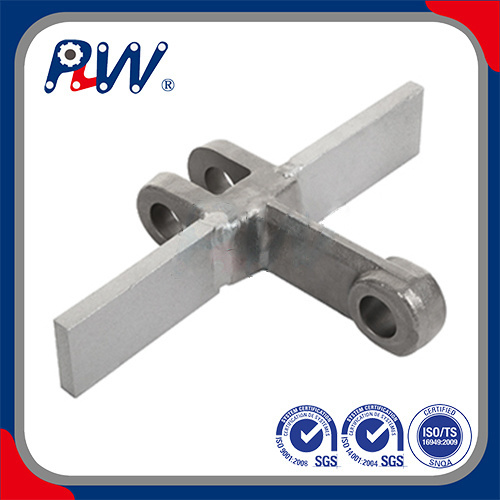
2. Impact of Continuous Loads on a Drop Forged Chain Heavy Duty Industrial System
Drop forging specifically resists intense industrial stresses much better than cast or stamped alternatives. The forging process compresses the steel grain structure. It aligns the internal grain to follow the exact contour of the link. This metallurgical advantage prevents sudden fractures under severe operating conditions.
You must differentiate between shock loads and steady-state operation. Steady continuous running causes gradual, predictable abrasive wear. Conversely, sudden starts, jams, or material surges create massive shock loads. A drop forged chain heavy duty industrial setup absorbs these shocks through a ductile inner core. If the links were uniformly hardened, a sudden jam would shatter them instantly.
Environmental factors drastically alter wear rates. Daily exposure to extreme heat degrades standard lubricants rapidly. For example, moving hot clinker bakes off protective oils. This leaves metal rubbing directly against metal. Corrosive environments similarly attack the steel chemistry. Acidic ash or wet industrial sludge alters the steel temper. It strips away the protective oxidized layers, exposing raw metal to accelerated decay.
Finally, we cannot isolate chain performance from sprocket wear. They operate as an interlinked mechanical ecosystem. Daily use aggressively alters the sprocket engagement angle. When sprocket teeth lose their original profile, they transfer abnormal stress directly to the chain links. A severely worn sprocket will destroy a brand-new chain in weeks. You must always evaluate and replace them as a paired assembly.
3. Monitoring Degradation: When Does Wear Become a Cost Risk?
Establishing clear thresholds for safe operation prevents catastrophic failure. We must establish objective evaluation criteria. Relying on visual guesses invites sudden equipment failure. You need structured, measurable protocols to monitor ongoing degradation.
The 3% elongation rule is the universally accepted industry benchmark. Measure a specific number of pitches across a tensioned section. Once elongation reaches 2-3% over the nominal length, the risk of failure spikes. The lengthened chain will begin skipping over sprocket teeth. This skipping violently jerks the entire conveyor system. You must schedule replacement immediately upon hitting this threshold.
Visual and auditory indicators provide early warnings. You should look closely at the pins during maintenance windows. Galling or deep scoring on pins indicates severe lubrication failure. Uneven side-wear on the links signals track misalignment. You should also listen to the system. Distinct popping, grinding, or slapping noises signal compromised engagement geometry.
We must operate under transparent assumptions. All mechanical components will eventually wear out. Engineered systems do not offer infinite life. The primary engineering goal is maximizing the predictability of that wear. Predictability allows you to schedule maintenance exclusively during planned outages. This prevents expensive mid-shift production halts.
Chart: Operational Degradation and Troubleshooting Summary
| Wear Indicator | Primary Cause | Operational Severity | Recommended Action |
| Over 3% Pitch Elongation | Internal pin/bore friction | Critical Risk | Replace chain and inspect sprockets. |
| Pin Galling | Lubrication failure / grit intrusion | High Risk | Upgrade sealing or switch to dry-film lube. |
| Uneven Side Wear | Conveyor track misalignment | Moderate Risk | Re-align drive and tail shafts immediately. |
| Loud Slapping Noise | Excessive slack / sprocket wear | High Risk | Adjust tensioners; check tooth profiles. |
4. Matching Drop Forged Chains Specifications to Your Daily Throughput
You must read technical spec sheets through the lens of daily operational realities. A catalog number alone guarantees nothing. Evaluating the precise metallurgical balance ensures the equipment survives your specific throughput demands.
Optimal drop forged chains specifications require a dual-hardness profile. You need a deeply case-hardened exterior. This outer layer typically registers at 50-60 HRC. It provides maximum resistance against abrasive grinding. However, the inner core must remain highly ductile. The core usually stays between 30-40 HRC. This softer center absorbs sudden operational shocks without shattering.
Engineers often mistakenly size systems based purely on Ultimate Breaking Strength (UBS). This is a common and dangerous trap. UBS merely indicates the exact point of catastrophic snapping under static laboratory tension. It ignores dynamic daily fatigue. Instead, you must calculate the Working Load Limit (WLL). We strongly advise applying a 6:1 to 10:1 safety factor. The exact multiplier depends entirely on your daily shock load severity.
Material selection dictates long-term survival. You cannot use a one-size-fits-all approach. Evaluate the exact chemistry of the forged steel.
Table: Standard Material Selection Guidelines
| Steel Grade | Primary Characteristic | Best Application Environment |
| 40Cr (Alloy Steel) | High tensile strength and good hardenability. | General heavy-duty transport, low-to-medium abrasion. |
| 20CrMnTi | Excellent deep case hardening and core toughness. | High-abrasion zones, cement clinker, ash handling. |
| Stainless Alloys | Superior oxidation and chemical resistance. | Corrosive environments, washdown areas, high moisture. |
5. Selecting a Drop Forged Chains Supplier for Long-Term Reliability
Evaluating vendors requires strict commercial logic and risk reduction protocols. You are not just buying steel links. You are securing operational uptime for your entire facility. A weak vendor introduces unacceptable supply chain vulnerabilities.
We advise demanding complete traceability. Buyers must require Material Test Reports (MTRs) before taking delivery. You should also request proof-loading documentation. A reliable drop forged chains supplier willingly provides metallurgical certificates. These documents guarantee their performance claims match your heavy-duty industrial conditions. If a vendor hesitates to prove their steel chemistry, disqualify them immediately.
Customization capabilities distinguish premium partners from basic distributors. Your facility likely has unique wear zones. Look for suppliers capable of engineering specialized treatments.
- Induction-Hardened Pins: Extends life in highly abrasive ash or cement lines.
- Custom Flight Attachments: Maximizes volumetric throughput for specific bulk materials.
- Specialized Clearances: Prevents fine grit from jamming the articulation joints.
- Dry-Film Coatings: Eliminates sticky wet lubricants in dusty environments.
Finally, assess their lead times and inventory support. Inevitable changeouts require immediate parts availability. Assess their ability to maintain dedicated safety stock for your facility. Mitigating the risk of extended downtime requires a vendor who proactively manages logistical delays.
Conclusion
Daily operational use will inevitably cause pitch elongation and surface wear. However, precision-engineered drop forged chains make this degradation exceptionally slow and entirely predictable. You control the failure timeline through proactive engineering choices rather than passive observation.
Evaluating long-term performance requires moving beyond basic catalog load charts. You must deeply understand the metallurgical interplay between case depth and core ductility. Matching these internal material properties to your external operating environment guarantees superior uptime.
Next Step Actions:
- Conduct a comprehensive tension and elongation audit on all currently operating chains.
- Document any uneven wear patterns or abnormal acoustic signatures during your next shift.
- Consult an established, certified supplier to audit your existing specifications against your actual daily throughput data.
- Upgrade components showing premature fatigue before they trigger an unplanned plant shutdown.
FAQ
Q: How often should drop forged chains be inspected under daily continuous use?
A: You must perform visual inspections weekly to check for track misalignment or severe dry-running. Measure elongation monthly using precise pitch gauges. Highly abrasive environments like cement or ash handling may require bi-weekly elongation checks to prevent sudden failure.
Q: What is the first sign that daily heavy-duty industrial loads are exceeding the chain's capacity?
A: The earliest warning is localized plastic deformation, such as bent pins or crushed link bores. Rapid early-stage elongation beyond standard run-in wear clearly indicates the operational loads far exceed the specified working load limit.
Q: Can lubrication significantly extend the life of drop forged chains?
A: Yes, proper lubrication drastically reduces internal pin-to-bore friction. However, in highly abrasive environments, standard wet oils attract grit and create a grinding paste. You must use dry-film alternatives or specify self-clearing joint designs to prevent accelerated wear.
Q: Why do identical drop forged chains specifications perform differently in the same daily application?
A: Performance variances usually stem from manufacturing inconsistencies. Uneven heat treatment creates soft spots, while loose machining tolerances allow abrasive grit to penetrate joints faster. This reality reinforces the critical importance of rigorous vendor vetting and demanding metallurgical test reports.

 Español
  English
  العربية
  Français
  Русский
  Português
  Deutsch
  italiano
  日本語
日本語  한국어
한국어  Nederlands
  Tiếng Việt
  ไทย
ไทย  Polski
  Türkçe
  አማርኛ
አማርኛ  ພາສາລາວ
  ភាសាខ្មែរ
  Bahasa Melayu
  ဗမာစာ
ဗမာစာ  தமிழ்
தமிழ்  Filipino
  Bahasa Indonesia
  magyar
  Română
  Čeština
  Монгол
  қазақ
қазақ  Српски
  हिन्दी
  فارسی
فارسی  Kiswahili
  Slovenčina
  Slovenščina
  Norsk
Norsk  Svenska
  українська
  Ελληνικά
  Suomi
Suomi  Հայերեն
  עברית
עברית  Latine
  Dansk
Dansk  اردو
اردو  Shqip
Shqip  বাংলা
বাংলা  Hrvatski
  Afrikaans
  Gaeilge
  Eesti keel
  Māori
Māori  සිංහල
සිංහල  नेपाली
  Oʻzbekcha
  latviešu
  অসমীয়া
  Aymara
  Azərbaycan dili
  Bamanankan
  Euskara
  Беларуская мова
  भोजपुरी


