Engineers and procurement teams constantly face a difficult choice. You must balance the immediate availability of standard off-the-shelf power transmission parts against the optimized performance of custom-engineered solutions. Making the wrong choice severely impacts your bottom line. It slows down production and frustrates maintenance staff.
Standard components easily meet requirements for about 80% of typical use cases. However, forcing a standard part into a non-standard application leads to disastrous results. You risk accelerated wear, sudden chain failure, and costly unplanned downtime. Incompatible parts vibrate excessively. They generate heat and destroy surrounding machinery.
This article provides a strictly objective, engineering-focused framework for this procurement decision. You will learn exactly when customization yields a positive Return on Investment (ROI). We will guide you through crucial engineering triggers, financial assessments, and hidden implementation risks. You can then make confident, data-backed sourcing decisions.
Key Takeaways
- Customization is justified when facing non-standard bore sizes, extreme environmental conditions, or highly specialized machinery footprints.
- The initial premium for custom engineering is typically offset by increased operational lifespan and reduced maintenance downtime.
- Accurate sprockets specifications (pitch, tooth count, bore, material) are the single most critical factor in a successful custom order.
- Partnering with a vetted sprockets supplier reduces supply chain risks associated with custom component lead times.
The Business Case: Off-the-Shelf vs. Custom Sprockets
Defining Success Criteria
You must define what a successful procurement choice actually looks like before evaluating parts. Success usually means maximizing equipment uptime while minimizing unit cost. It also means keeping lead times manageable. You need a reliable supply of replacement parts. A successful choice aligns directly with your production schedules. If your facility cannot tolerate unexpected downtime, your success criteria must prioritize durability over upfront savings.
The Standard Approach
ANSI and DIN standard components offer undeniable advantages. You enjoy immediate availability from multiple industrial distributors. Standard parts feature highly predictable pricing. They also offer universal interchangeability across different brands. If a standard component fails, maintenance teams simply grab a replacement from the tool crib. You do not wait weeks for a specialized delivery. Standard designs work perfectly for low-speed, low-stress applications. They remain the default choice for general material handling operations.
The Custom Approach
Customization offers a completely different financial rationale. Custom parts eliminate the need for dangerous aftermarket modifications. You integrate hubs and shafts into a single unit. This drastically reduces final assembly time on the factory floor. You also optimize materials for very specific wear patterns. An engineer might specify localized hardening on high-impact zones. These tailored adjustments solve recurring failure modes. They stop you from replacing the same broken parts every month.
Long-Term Financial Comparison
You must contrast the upfront cost of custom machining against long-term operational value. Custom orders require expensive initial tooling. They involve engineering fees and minimum order sizes. However, standard parts often fail rapidly in high-stress applications. You must factor in the labor cost of frequent replacements. Add the lost revenue from machine downtime. A custom part often costs three times as much upfront. Yet, it can easily last ten times longer in a harsh environment. This creates a superior long-term financial return.
4 Engineering Triggers That Require Customization
- Unique Shaft and Hub Configurations: Standard bore sizes rarely accommodate proprietary OEM equipment. Legacy machinery often features unusual keyways. Set screw configurations might not match off-the-shelf options. Customization becomes necessary when you cannot alter the existing drive shaft. You must design the power transmission component to fit the machine perfectly.
- Harsh Operational Environments: Standard carbon steel fails rapidly due to abrasion or chemical exposure. You must upgrade materials to survive these conditions. For instance, you might require durable cast iron sprockets for industrial processing applications. Cast iron resists wear in highly abrasive environments better than mild steel. Other environments demand specialized anti-corrosive coatings or specialized metallurgy. Custom engineering solves these environmental challenges permanently.
- Space and Weight Constraints: Modern robotics and specialized automation rely on compact designs. Standard profiles are often too heavy. They carry excess material bulk. This extra weight drains motor efficiency. Standard profiles might also physically interfere with adjacent mechanisms. Custom designs shave off unnecessary weight. They feature slimmed-down hubs and precise dimensional footprints.
- Non-Standard Chain Integration: You might need to match a highly specific or obsolete chain pitch. Standard market availability often dries up for legacy machinery. If you cannot find the right pitch off the shelf, you face a crisis. You either retrofit the entire conveyor system or machine a custom part. Custom manufacturing is almost always cheaper than a total system retrofit.
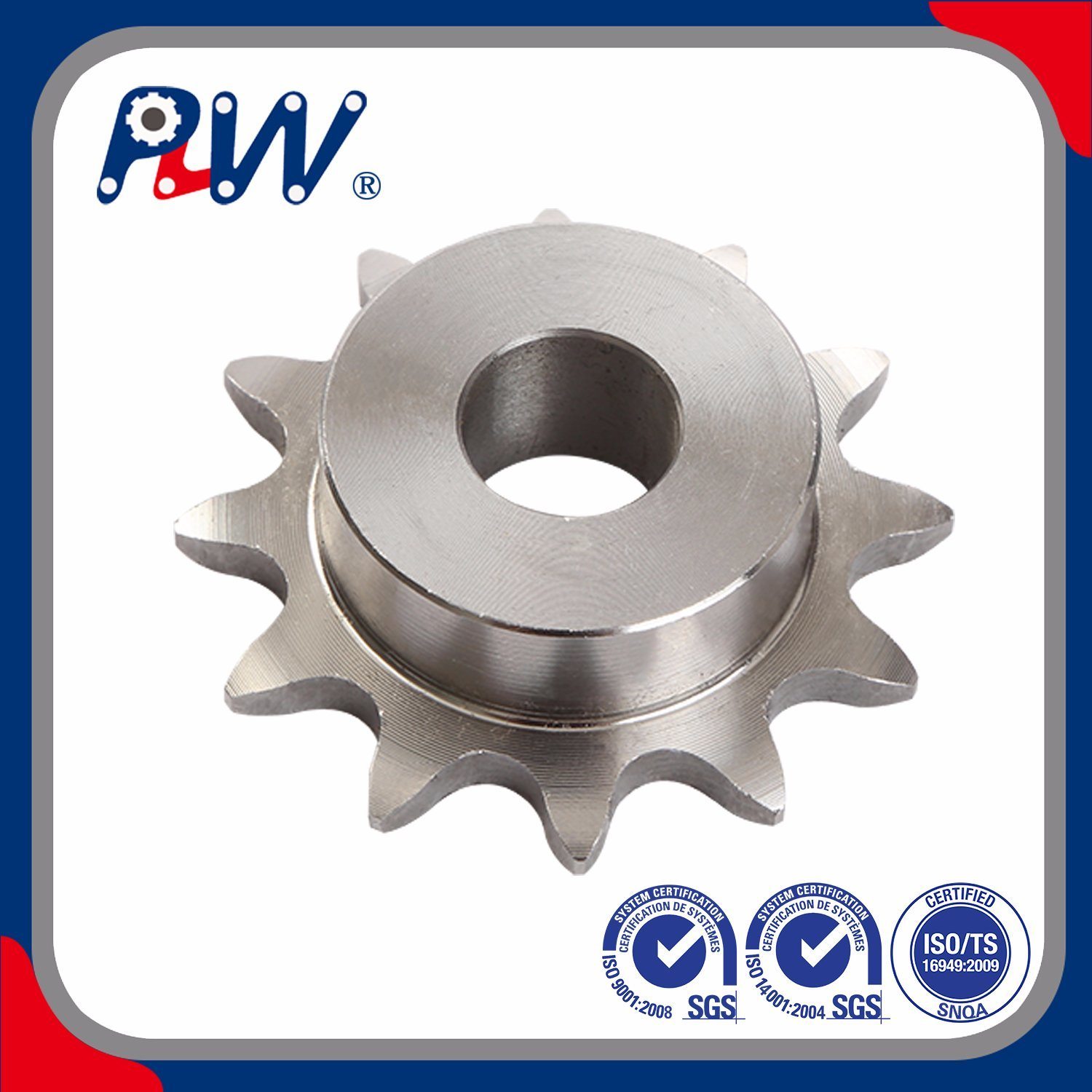
Defining Your Custom Sprockets Specifications
You must establish highly accurate sprockets specifications early in the design phase. Poorly defined requirements lead to mismatched parts and immediate mechanical failure. Precision is non-negotiable.
Dimensional Tolerances
You must establish strict dimensional requirements to prevent chain jump. Pay close attention to pitch diameter and outside diameter. The bottom caliper diameter requires exact tolerances. If these dimensions vary by even a fraction of a millimeter, the chain will not seat correctly. This causes erratic tension. It ultimately snaps the chain under heavy loads. You must document acceptable variance levels on your technical drawings.
Tooth Profile & Count
Engineers must calculate the exact tooth geometry required for specific speed ratios. Load distributions dictate the thickness and angle of the teeth. High-speed applications need modified tooth profiles for smooth engagement. Fewer teeth increase the articulation angle of the chain. This accelerates wear on the pins. Custom designs let you optimize the exact tooth count for your specific RPM targets.
Material & Heat Treatment Selection
Material choices define the lifespan of your custom component. You must navigate several technical evaluation criteria. Consider induction-hardened teeth for heavy industrial loads. Look at food-grade stainless steel for sanitary environments. You might need specialized alloys for high-impact shock loads. Heat treatments alter the grain structure of the metal. They provide a hard exterior shell while maintaining a ductile core. This prevents the metal from shattering under sudden impacts.
Table 1: Material Performance Comparison
| Material Type | Primary Advantage | Best Application Environment | Relative Cost |
| Carbon Steel | High tensile strength, easy to machine | General industrial, low moisture | Low |
| Cast Iron | Excellent wear and abrasion resistance | Mining, heavy material handling | Medium |
| Stainless Steel | Corrosion resistance, sanitary compliance | Food processing, chemical plants | High |
| Specialty Alloys | Extreme shock load absorption | High-torque robotics, heavy automation | Very High |
Surface Finishes
Surface finishes protect the underlying metal from environmental degradation. You must specify the correct coating based on the operational environment. Black oxide provides mild corrosion resistance and reduces light reflection. Zinc plating offers a strong sacrificial barrier against moisture. Specialized anti-corrosive epoxy coatings withstand direct chemical washdowns. Choosing the right finish prevents premature rust and extends the functional life of the part.
Hidden Costs and Implementation Risks
Minimum Order Quantities (MOQs)
Custom manufacturing runs typically carry high Minimum Order Quantities. You must assess the financial risk of these MOQs. Foundries and machine shops cannot profitably set up custom tooling for a single unit. They often require orders of 50 to 100 pieces. You tie up significant capital in spare parts inventory. You must calculate whether the long-term operational savings justify this large upfront expenditure.
Lead Time and Supply Chain Vulnerability
Custom tooling inherently introduces severe lead time risks. You often wait 6 to 12 weeks for delivery. This impacts your spare parts inventory strategy drastically. You cannot rely on next-day shipping if a custom part breaks. You must warehouse your own safety stock. A miscalculation in inventory levels leaves your production line paralyzed for months while waiting for a new batch.
Vendor Lock-In
Proprietary designs create a high risk of vendor lock-in. You become entirely reliant on a single manufacturer. If that facility experiences a strike, fire, or quality drop, you have no backup. Competitors cannot instantly reproduce the custom geometry without reverse engineering it first. This gives the original vendor immense pricing power during contract renewals. You must secure ownership of all CAD files and technical drawings to mitigate this.
Prototyping Bottlenecks
Initial design iterations often fail during real-world load testing. Mathematical models do not always predict dynamic physical stresses perfectly. You might discover that your custom profile generates unexpected harmonic vibrations. You then need a second or third prototyping round. Each iteration adds weeks to the timeline. Full production cannot begin until the prototype passes rigorous field testing. You must build generous buffer time into your project schedule.
How to Shortlist a Reliable Sprockets Supplier
Choosing a reliable sprockets supplier requires careful vetting. You need a partner, not just a machine shop. They must manufacture high-quality sprockets reliably over many years.
In-House Engineering Capabilities
You must evaluate a supplier’s internal engineering resources. Do they provide advanced CAD modeling? Can they perform Finite Element Analysis (FEA) to simulate stress loads? You need a vendor capable of reverse-engineering legacy parts accurately. If a supplier outsources their engineering work, communication breaks down. In-house engineers collaborate directly with machinists. This ensures your theoretical design translates perfectly into physical reality.
Material Traceability and Quality Assurance
Quality assurance separates elite manufacturers from average job shops. You must ensure the vendor provides official mill certificates. These documents prove the exact chemical composition of the raw steel. Furthermore, the supplier must utilize Coordinate Measuring Machine (CMM) inspections. CMM verifies dimensional accuracy down to the micron. Without strict material traceability, you risk receiving parts made from inferior, recycled scrap metal. This compromises structural integrity entirely.
Production Scalability
Assess whether the manufacturer can scale production to meet your future needs. Some shops excel at small-batch prototypes but fail at high-volume runs. Others demand massive volumes and refuse prototype work. You need a partner who handles both extremes efficiently. They should seamlessly transition your project from a 5-piece test batch to a 5,000-piece annual production run. This prevents you from switching vendors mid-project.
Inventory Management Programs
Look for manufacturing partners who offer proactive inventory solutions. They should provide blanket orders or dedicated safety stock agreements. Under these programs, the vendor manufactures a large batch but stores it at their facility. They ship individual releases to you on demand. This entirely mitigates the 12-week custom lead time. You get custom-part performance with off-the-shelf delivery speeds. It requires strong trust and financial stability from both parties.
Conclusion
- Default to standard, off-the-shelf components for common, low-stress applications to save money and reduce lead times.
- Invest confidently in custom engineering when extreme environmental, dimensional, or performance demands cause standard parts to fail repeatedly.
- Always retain legal ownership of your custom CAD files and technical drawings to prevent restrictive vendor lock-in.
- Audit your current maintenance logs today to identify recurring power transmission failure points on your factory floor.
- Consult with a qualified mechanical engineer to draft initial technical drawings before approaching a manufacturer for a quote.
FAQ
Q: How much more do custom sprockets cost compared to standard ones?
A: The initial cost premium typically ranges from 30% to over 200%. This depends heavily on tooling requirements, specialized metallurgy, and minimum order quantities. However, this upfront expense is usually offset by drastically increased operational lifespan and eliminated downtime.
Q: What is the typical lead time for a custom order?
A: You should expect a realistic baseline of 4 to 10 weeks. This timeline fluctuates based on raw material availability, required heat treatments, and the complexity of initial tooling creation. Prototyping iterations will extend this timeline further.
Q: Can I modify a standard off-the-shelf sprocket instead of ordering custom?
A: Post-machining a standard part carries significant risks. Boring out a center hole might compromise the structural integrity of the hub. Furthermore, welding or cutting usually destroys the factory heat-treatment benefits, leaving the metal weak and prone to rapid failure.
Q: What information do I need to get a quote for a custom sprocket?
A: You must provide the exact chain size (pitch), required tooth count, specific bore size, and keyway dimensions. You should also state your material preference, expected operational RPM, and the maximum anticipated load conditions.

 Español
  English
  العربية
  Français
  Русский
  Português
  Deutsch
  italiano
  日本語
日本語  한국어
한국어  Nederlands
  Tiếng Việt
  ไทย
ไทย  Polski
  Türkçe
  አማርኛ
አማርኛ  ພາສາລາວ
  ភាសាខ្មែរ
  Bahasa Melayu
  ဗမာစာ
ဗမာစာ  தமிழ்
தமிழ்  Filipino
  Bahasa Indonesia
  magyar
  Română
  Čeština
  Монгол
  қазақ
қазақ  Српски
  हिन्दी
  فارسی
فارسی  Kiswahili
  Slovenčina
  Slovenščina
  Norsk
Norsk  Svenska
  українська
  Ελληνικά
  Suomi
Suomi  Հայերեն
  עברית
עברית  Latine
  Dansk
Dansk  اردو
اردو  Shqip
Shqip  বাংলা
বাংলা  Hrvatski
  Afrikaans
  Gaeilge
  Eesti keel
  Māori
Māori  සිංහල
සිංහල  नेपाली
  Oʻzbekcha
  latviešu
  অসমীয়া
  Aymara
  Azərbaycan dili
  Bamanankan
  Euskara
  Беларуская мова
  भोजपुरी


