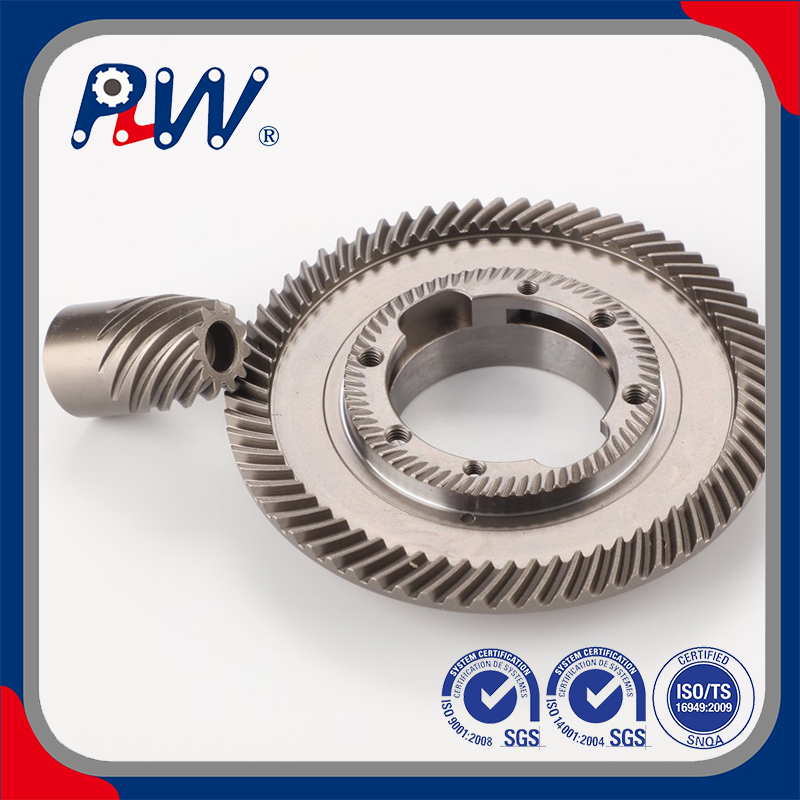
High-Precision Spiral Gear – Alloy Steel for Heavy-Duty Industrial Power Transmission
Precision-Engineered Spiral Gear for High-Load, Smooth and Reliable Industrial Drive Systems
Our High-Precision Spiral Gear is engineered for demanding mechanical power transmission systems where accurate tooth geometry, stable torque transfer, wear resistance, and long-term dimensional consistency are essential.
Manufactured from high-strength alloy steel and processed through controlled machining and heat-treatment procedures, the gear is designed to provide reliable performance in industrial gearboxes, speed reducers, automated machinery, material handling equipment, production lines, and other heavy-duty transmission systems.
The spiral tooth configuration provides progressive tooth engagement, helping distribute transmitted load over the tooth contact area and supporting smooth, stable operation when properly matched with the mating gear.
Key Product Features
High-Precision Tooth Geometry
Controlled tooth profile, pitch, lead, and concentricity help achieve accurate gear meshing and consistent transmission performance.
Gear flank accuracy can be specified according to applicable ISO, DIN, AGMA, or customer requirements. ISO 1328 provides a standardized classification framework for gear flank deviations and includes parameters such as pitch, profile, helix, and runout-related characteristics.
High-Strength Alloy Steel
Alloy steel provides a strong foundation for applications requiring high mechanical strength, fatigue resistance, and dimensional stability.
Material selection can be adapted according to transmitted torque, operating speed, tooth loading, heat-treatment requirements, and service environment.
Smooth Power Transmission
The spiral tooth geometry provides progressive engagement between mating teeth, supporting smooth torque transfer and reducing abrupt tooth engagement.
Heavy-Duty Load Capacity
Heat-treated alloy steel gear components can be engineered for demanding industrial transmission systems requiring high load-carrying capability and resistance to tooth wear and fatigue.
Wear-Resistant Tooth Surface
Depending on the application, gears can be supplied with carburizing, quenching and tempering, induction hardening, or other specified heat-treatment processes.
Stable Dimensional Accuracy
Controlled machining, heat-treatment procedures, and final inspection help maintain critical gear dimensions and tooth geometry.
OEM & Custom Manufacturing
Gear module, tooth number, pressure angle, helix/spiral parameters, bore, keyway, face width, material, heat treatment, accuracy grade, and other specifications can be customized according to drawings or samples.
Technical Specifications
| Specification | Typical Options / Engineering Requirements |
| Product Type | High-Precision Spiral Gear |
| Gear Configuration | Spiral / Helical-Type Cylindrical Gear |
| Application | Industrial Power Transmission |
| Material | Alloy Steel / Case-Hardening Steel / Customized |
| Typical Material Options | 20MnCr5 / 18CrNiMo7-6 / 20CrMnTi / AISI 8620 / AISI 9310 / Customized |
| Manufacturing Process | CNC Hobbing / Shaping / Milling / Grinding / Customized |
| Heat Treatment | Carburizing / Quenching & Tempering / Induction Hardening / Carbonitriding |
| Surface Hardness | According to material and heat-treatment specification |
| Effective Case Depth | According to gear design and load requirements |
| Module | Customized |
| Number of Teeth | Customized |
| Pressure Angle | Typically 20° / Customized |
| Helix Angle | According to gear design |
| Helix Direction | Left-Hand / Right-Hand |
| Pitch Diameter | According to module and tooth number |
| Outside Diameter | According to gear geometry |
| Root Diameter | According to gear geometry |
| Face Width | Customized |
| Bore Diameter | Customized |
| Keyway | Standard / Customized |
| Spline | Optional / Customized |
| Gear Accuracy | ISO / DIN / AGMA / Customer Specification |
| Tooth Surface Finish | Hobbing / Shaving / Honing / Grinding |
| Runout | According to drawing tolerance |
| Concentricity | According to drawing tolerance |
| Tooth Profile | Standard / Modified / Customized |
| Tooth Lead | Standard / Modified / Customized |
| Surface Treatment | Oil Protection / Anti-Corrosion Treatment / Customized |
| Inspection | Dimensional / Tooth Geometry / Hardness / Runout |
| Production | Prototype / Small Batch / Mass Production / OEM |
| Packaging | Export Carton / Wooden Case / Customized |
Engineering note: Actual material grades, hardness, case depth, accuracy class, helix angle, surface finish, and load capacity should be specified according to the final gear drawing and application. The values above are configuration options rather than universal specifications.
Spiral Tooth Geometry
The spiral tooth configuration is designed to provide progressive engagement between mating gear teeth.
Compared with a basic straight-tooth engagement, the angled tooth path allows the contact region to develop progressively across the tooth face.
This design can contribute to:
Smoother tooth engagement
More stable torque transmission
Reduced transmission shock
Improved load distribution
Lower vibration potential
Improved operating behavior at higher speeds
Actual performance depends on tooth geometry, gear accuracy, backlash, lubrication, load, speed, shaft alignment, and the complete gear-pair design.
Alloy Steel for Heavy-Duty Applications
Material selection is critical for spiral bevel gears operating under high torque, repeated loading and demanding industrial conditions.
Depending on the application, available alloy steel options may include:
20MnCr5
A case-hardening steel commonly considered for applications requiring a hard wear-resistant surface combined with a tough core.
18CrNiMo7-6
A high-performance carburizing steel option for demanding transmission applications where high load capacity and fatigue resistance are required.
20CrMnTi
A commonly used carburizing gear steel option for industrial transmission components.
AISI 8620 / AISI 9310
Available for applications requiring specific material standards and high-performance gear manufacturing.
Actual material selection should be based on gear load, operating speed, fatigue requirements, heat-treatment specification and customer engineering standards.
Heat Treatment and Tooth Surface Engineering
Heat treatment can significantly influence the service performance of spiral bevel gears.
Depending on the material and application, available processes include:
For case-hardened spiral bevel gears, the objective is generally to obtain a wear-resistant tooth surface while maintaining a sufficiently tough core.
Final hardness, effective case depth and heat-treatment requirements should be specified according to the actual gear design rather than using a generic hardness value.
Precision Spiral Bevel Gear Manufacturing
Our manufacturing process can be configured according to the required gear geometry, production volume and accuracy level.
1. Material Preparation
Approved alloy steel is prepared according to the customer's material and mechanical-property requirements.
2. Gear Blank Machining
Turning and CNC machining are used to establish the required blank dimensions, bore and reference surfaces.
3. Spiral Bevel Tooth Cutting
The spiral bevel tooth geometry is generated using dedicated bevel gear manufacturing technology.
4. Heat Treatment
The gears undergo the specified hardening or heat-treatment process.
5. Tooth Finishing
Depending on the application, tooth flanks can be finished by lapping, grinding or other specified processes.
Industrial spiral bevel gear production commonly involves stages such as cutting, measuring, hardening, grinding or lapping and final testing.
6. Final Inspection
Critical dimensions and tooth geometry are inspected before shipment.
Spiral Bevel Gear Inspection
For precision industrial applications, inspection can include:
| Inspection Item | Quality Control Focus |
| Tooth Profile | Profile deviation and tooth-form accuracy |
| Tooth Lead | Lead / alignment deviation |
| Tooth Pitch | Pitch and cumulative pitch accuracy |
| Radial Runout | Gear rotational accuracy |
| Tooth Thickness | Backlash and mating condition |
| Bore Diameter | Shaft fit and dimensional accuracy |
| Bore Concentricity | Relationship between bore and gear datum |
| Face Runout | Axial dimensional stability |
| Spiral Angle | Conformance to gear specification |
| Face Width | Dimensional verification |
| Surface Hardness | Heat-treatment verification |
| Case Depth | Effective hardened layer |
| Surface Roughness | Tooth-flank finishing quality |
| Tooth Contact Pattern | Proper mating between pinion and gear |
| Material | Material certificate / composition where required |
| Heat Treatment | Hardness and process verification |
| Final Dimensions | Drawing-based inspection |
For demanding applications, load capacity should be evaluated using the applicable bevel gear rating methodology. ISO 10300-1:2023 provides calculation methods for the load-carrying capacity of straight, skew, spiral bevel, Zerol and hypoid gears.
Tooth Contact Pattern Control
For a spiral bevel gear pair, correct tooth contact is essential for reliable power transmission.
The final contact pattern can be influenced by:
Therefore, tooth contact pattern inspection should be considered together with dimensional and tooth-geometry inspection, especially for precision gear pairs.
Applications
Our spiral bevel gears can be manufactured for a wide range of industrial transmission applications, including:
Industrial Gearboxes
Speed Reducers
Right-Angle Gear Drives
Heavy Machinery
Material Handling Equipment
Conveyor Drive Systems
Agricultural Machinery
Construction Equipment
Mining Machinery
Production Machinery
Automated Mechanical Systems
Industrial Drive Assemblies
Customized Transmission Systems
OEM Spiral Bevel Gear Manufacturing
We support drawing-based and specification-based OEM production for customized spiral bevel gears.
Available customization includes:
Customers can provide a 2D drawing, 3D CAD model, gear data sheet or existing sample for technical evaluation and quotation.
Designed for Reliable Industrial Power Transmission
A high-quality spiral bevel gear is not defined only by material hardness or dimensional accuracy. Reliable performance depends on the complete combination of:
Gear Geometry + Material + Heat Treatment + Tooth Accuracy + Surface Finish + Contact Pattern + Lubrication + Assembly Alignment
For this reason, our manufacturing approach focuses on controlling the complete production process rather than treating the gear as a simple machined component.
Quality Assurance
Quality control can be implemented throughout the production process, including:
Incoming material verification
Gear blank dimensional inspection
Tooth geometry inspection
Heat-treatment inspection
Hardness testing
Case-depth verification
Surface-finish inspection
Runout and concentricity inspection
Tooth contact pattern inspection
Final dimensional inspection
Batch traceability
Customer-specific inspection documentation
Why Choose Our Spiral Bevel Gears?
High-Precision Manufacturing
Controlled gear geometry and inspection procedures help maintain consistent transmission performance.
Heavy-Duty Material Options
Alloy steel and case-hardening steel options are available according to load and service requirements.
Customized Gear Geometry
We manufacture according to customer drawings, gear data and application-specific requirements.
Flexible Finishing Options
Lapping, grinding and other finishing processes can be selected according to accuracy and performance requirements.
OEM Production Capability
Suitable for prototypes, replacement gears, small-batch production and recurring OEM orders.
Engineering-Oriented Quality Control
Inspection can cover not only basic dimensions but also tooth geometry, hardness, case depth and contact pattern.
Request a Custom Spiral Bevel Gear Quote
Looking for a reliable spiral bevel gear manufacturer for your industrial transmission system?
Send us your drawing, CAD file, gear parameters, material specification or existing sample.
We can evaluate your requirements and provide a customized manufacturing solution for:
Spiral Bevel Gear + Pinion Sets | Alloy Steel Gears | Heat-Treated Gears | Ground or Lapped Gears | OEM Custom Gears

 Español
  English
  العربية
  Français
  Русский
  Português
  Deutsch
  italiano
  日本語
日本語  한국어
한국어  Nederlands
  Tiếng Việt
  ไทย
ไทย  Polski
  Türkçe
  አማርኛ
አማርኛ  ພາສາລາວ
  ភាសាខ្មែរ
  Bahasa Melayu
  ဗမာစာ
ဗမာစာ  தமிழ்
தமிழ்  Filipino
  Bahasa Indonesia
  magyar
  Română
  Čeština
  Монгол
  қазақ
қазақ  Српски
  हिन्दी
  فارسی
فارسی  Kiswahili
  Slovenčina
  Slovenščina
  Norsk
Norsk  Svenska
  українська
  Ελληνικά
  Suomi
Suomi  Հայերեն
  עברית
עברית  Latine
  Dansk
Dansk  اردو
اردو  Shqip
Shqip  বাংলা
বাংলা  Hrvatski
  Afrikaans
  Gaeilge
  Eesti keel
  Māori
Māori  සිංහල
සිංහල  नेपाली
  Oʻzbekcha
  latviešu
  অসমীয়া
  Aymara
  Azərbaycan dili
  Bamanankan
  Euskara
  Беларуская мова
  भोजपुरी